Arjun invests Rs. 20,000 in two parts, one part at 8% per annum and the other at 12% per annum interest. His yearly average interest rate comes out to be 9% per annum . Then which of the following are true ?
A. He invests Rs. 15,000 @ 8% interest
B. He invests Rs. 10,000 @ 12% interest
C. He invests Rs. 6000 @ 8% interest
D. He invests Rs. 5,000 @ 12% interest
Choose the correct answer from the options given below:
Answer & explanation
Correct answer: option 3
The correct answer is Option (3) → A and D only
Let Rs. x be invested at 8%; then Rs. (20000 − x) is at 12%. The total interest equals 9% of the whole amount:
\( \displaystyle 0.08x+0.12(20000-x)=0.09\times 20000 \)
\( \displaystyle 0.08x+2400-0.12x=1800 \)
\( \displaystyle 0.04x=600\ \Rightarrow\ x=15000 \)
So Rs. 15,000 is invested at 8% and Rs. 5,000 at 12%.
Checking the statements
(A) He invests Rs. 15,000 @ 8% interest — Correct. x = 15,000.
(B) He invests Rs. 10,000 @ 12% interest — Incorrect. The amount at 12% is Rs. 5,000.
(C) He invests Rs. 6000 @ 8% interest — Incorrect. The amount at 8% is Rs. 15,000.
(D) He invests Rs. 5,000 @ 12% interest — Correct. 20,000 − 15,000 = 5,000.
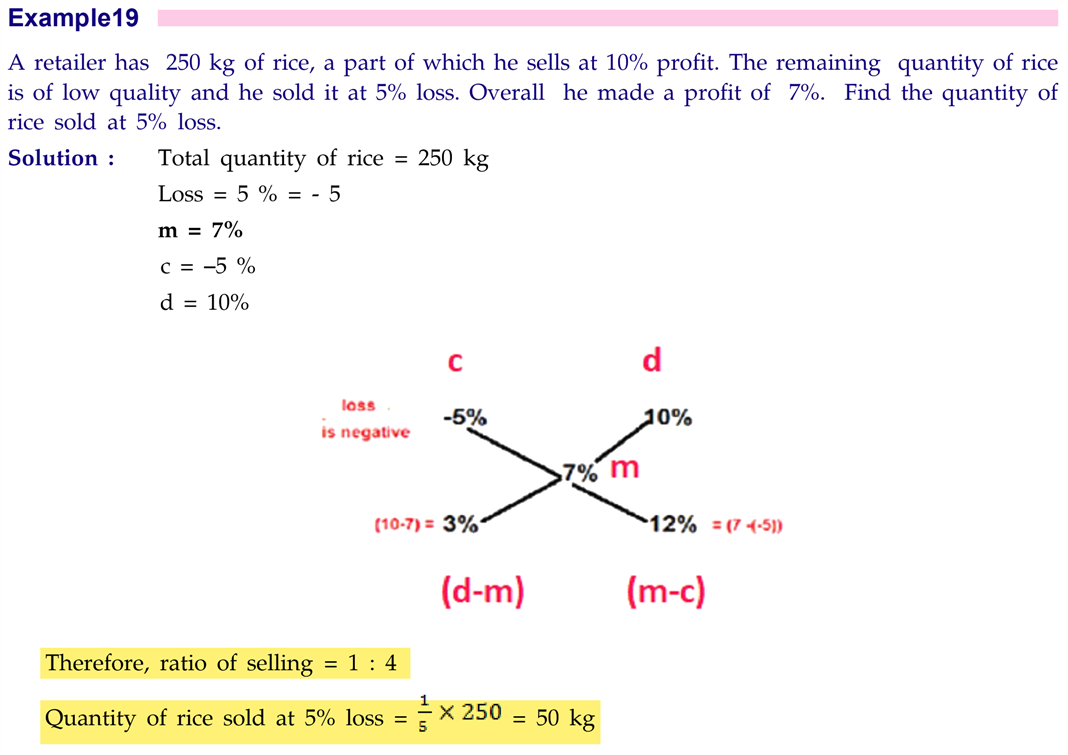
Shortcut: By alligation, the amounts are in the ratio (12 − 9) : (9 − 8) = 3 : 1 for 8% : 12%, giving Rs. 15,000 and Rs. 5,000.
CBSE Applied Mathematics (Class XII):
Alligation and Mixture