Select the incorrect statement with reference to Arrhenius theory.
Answer & explanation
Correct answer: option 3
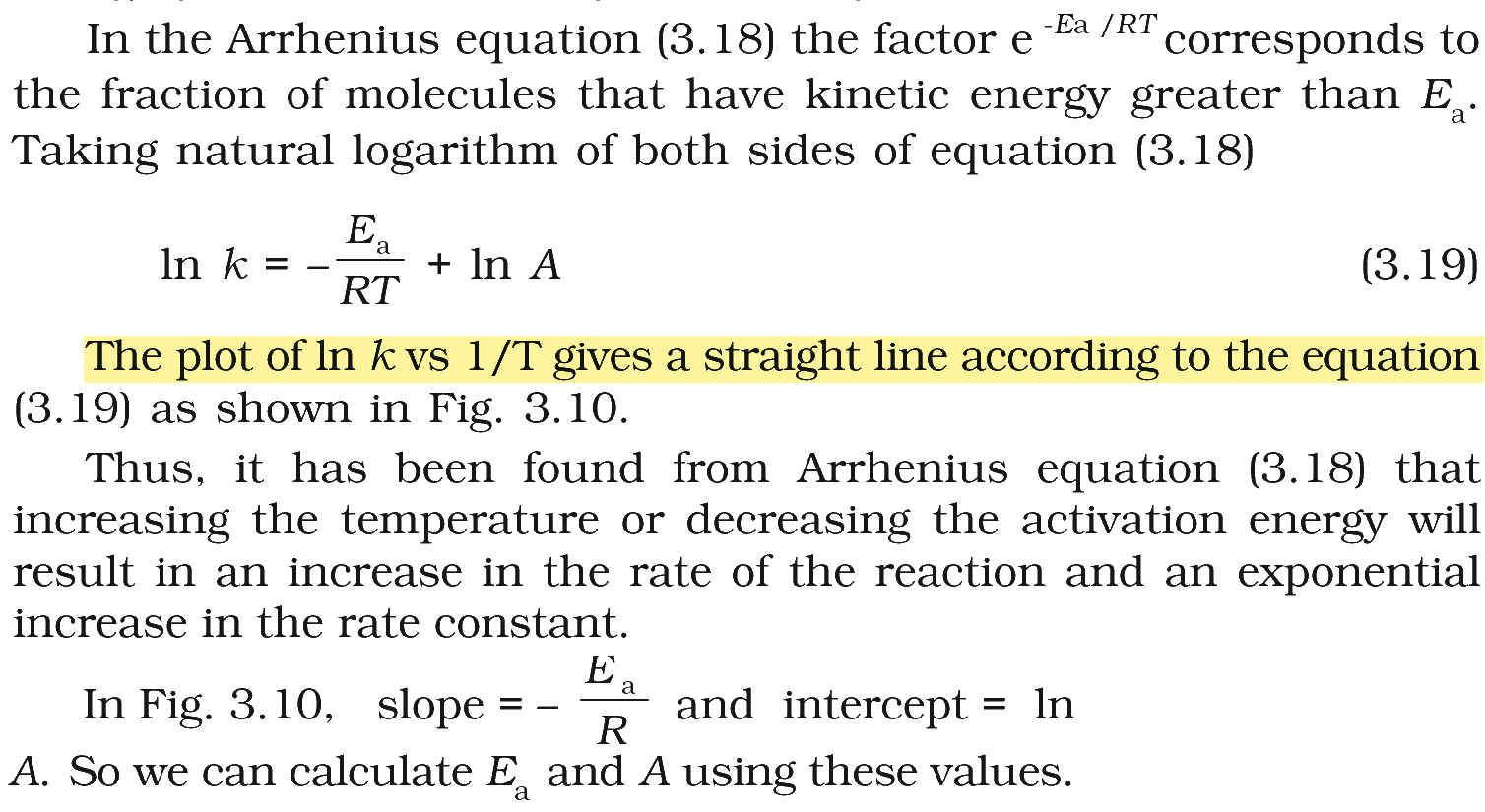
The correct answer is Option (3) → The plot of rate constant (k) vs 1/T is a straight line.
According to the Arrhenius theory, reactant molecules must collide and form an unstable activated complex, which needs the activation energy Ea. The rate constant depends on temperature as:
\( \displaystyle k=A\,e^{-E_a/RT} \)
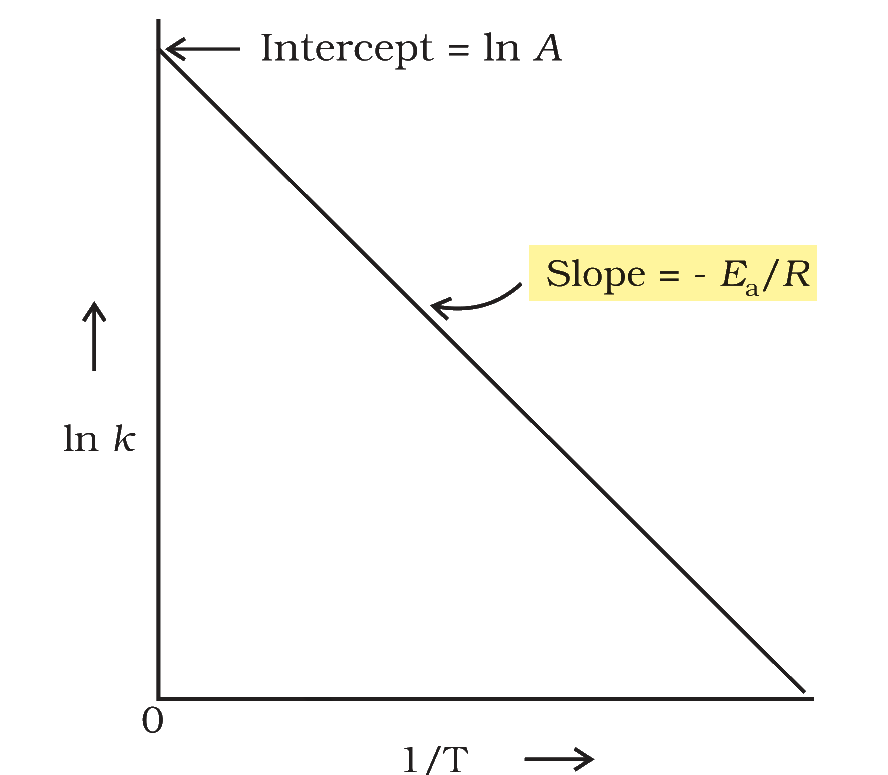
This is an exponential relation, so k plotted against 1/T gives a curve, not a straight line. Taking natural logarithms gives a straight-line form:
\( \displaystyle \ln k=\ln A-\frac{E_a}{R}\times\frac{1}{T} \)
\( \displaystyle \log k=\log A-\frac{E_a}{2.303R}\times\frac{1}{T} \)
Option (1) Some energy is released when the complex decomposes to form products. — A correct statement of Arrhenius theory. The activated complex lies at the top of the energy barrier, so energy is released as it breaks up into products.
Option (2) The final enthalpy of the reaction depends upon the nature of reactants and products. — A correct statement of Arrhenius theory. The reaction enthalpy is the difference between the energies of products and reactants, whatever the path.
Option (3) The plot of rate constant (k) vs 1/T is a straight line. — The incorrect statement. It is the plot of ln k (or log k) vs 1/T that is a straight line, with slope −Ea/R; k itself against 1/T gives a curve.
Option (4) Activation Energy for the catalyzed as well as for uncatalysed reaction can be calculated by the Arrhenius equation. — A correct statement of Arrhenius theory. For either reaction, measuring k at two temperatures gives Ea: \( \log\frac{k_2}{k_1}=\frac{E_a}{2.303R}\times\frac{T_2-T_1}{T_1T_2} \)
NCERT (2026-27 edition):
Temperature Dependence of the Rate of a Reaction – …