If \(\hat{\imath}, \hat{\jmath}\) and \(\hat{k}\) are unit vectors along the co-ordinate axes OX, OY and OZ respectively, then
(A) \(\hat{\imath} \times \hat{\jmath} = \hat{k}\)
(B) \(\hat{k} \times \hat{\imath} = -\hat{\jmath}\)
(C) \(\hat{\jmath} \cdot \hat{\jmath} = 1\)
(D) \(\hat{\jmath} \cdot \hat{k} = 0\)
Choose the correct answer from the options given below:
Answer & explanation
Correct answer: option 4
The correct answer is Option (4) → (A), (C) and (D) only
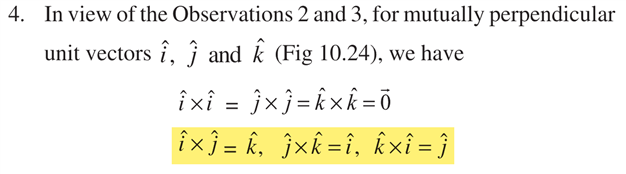
The cross products of the unit vectors taken in the cyclic order \(\hat{\imath} \to \hat{\jmath} \to \hat{k} \to \hat{\imath}\) are positive:
\(\hat{\imath} \times \hat{\jmath} = \hat{k}\)
\(\hat{\jmath} \times \hat{k} = \hat{\imath}\)
\(\hat{k} \times \hat{\imath} = \hat{\jmath}\)
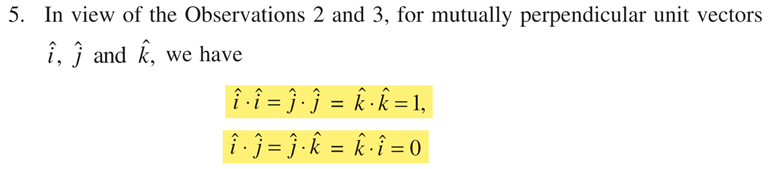
The unit vectors have length 1 and are mutually perpendicular, so for the dot products:
\(\hat{\jmath} \cdot \hat{\jmath} = 1\)
\(\hat{\jmath} \cdot \hat{k} = 0\)
So \(\hat{\imath} \times \hat{\jmath} = \hat{k}\), \(\hat{k} \times \hat{\imath} = \hat{\jmath}\), \(\hat{\jmath} \cdot \hat{\jmath} = 1\) and \(\hat{\jmath} \cdot \hat{k} = 0\).
Checking the statements
(A) \(\hat{\imath} \times \hat{\jmath} = \hat{k}\) — Correct. Cyclic order.
(B) \(\hat{k} \times \hat{\imath} = -\hat{\jmath}\) — Incorrect. \(\hat{k} \times \hat{\imath} = +\hat{\jmath}\) (cyclic order); \(-\hat{\jmath}\) is \(\hat{\imath} \times \hat{k}\).
(C) \(\hat{\jmath} \cdot \hat{\jmath} = 1\) — Correct. \(|\hat{\jmath}|^2 = 1\).
(D) \(\hat{\jmath} \cdot \hat{k} = 0\) — Correct. \(\hat{\jmath}\) and \(\hat{k}\) are perpendicular.
NCERT (2026-27 edition):
Product of Two Vectors