
The major product (P) for the following chemical transformation is.
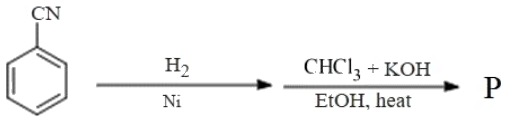
Answer & explanation
Correct answer: option 1
The correct answer is Option (1) → C6H5-CH2NC
Two reactions are involved:
Catalytic reduction of a nitrile: \( \ce{H2} \)/Ni reduces –C≡N to –\( \ce{CH2NH2} \), giving a primary amine with the same number of carbon atoms.
Carbylamine reaction: a primary amine heated with chloroform and ethanolic KOH gives an isocyanide (carbylamine), which has a very unpleasant smell. Secondary and tertiary amines do not give this reaction, so it is a test for primary amines.
Benzonitrile is first reduced to benzylamine:
\( \displaystyle \ce{C6H5-C#N + 2H2} \xrightarrow{\ce{Ni}} \ce{C6H5-CH2NH2} \)
Benzylamine then gives benzyl isocyanide:
\( \displaystyle \ce{C6H5CH2NH2 + CHCl3 + 3KOH} \xrightarrow{\Delta} \ce{C6H5CH2NC + 3KCl + 3H2O} \)
So P is C6H5–CH2NC.
Why the other options are incorrect
Option (2) C6H5NC — Incorrect. Phenyl isocyanide comes from aniline. Here the \( \ce{CH2} \) formed on reducing the nitrile stays between the ring and N.
\( \displaystyle \ce{C6H5NH2 + CHCl3 + 3KOH} \xrightarrow{\Delta} \ce{C6H5NC + 3KCl + 3H2O} \)
Option (3) Salicylic acid — Incorrect. It is made from phenol by the Kolbe reaction (sodium phenoxide + \( \ce{CO2} \)), not from an amine.
\( \displaystyle \ce{C6H5ONa} \xrightarrow[\text{(ii) }\ce{H+}]{\text{(i) }\ce{CO2}} \ce{2-HOC6H4COOH} \)
Option (4) Salicylaldehyde — Incorrect. It is made from phenol with \( \ce{CHCl3} \) and aqueous NaOH (Reimer–Tiemann reaction). The reagent looks similar, but the substrate here is an amine, not a phenol.
\( \displaystyle \ce{C6H5OH} \xrightarrow[\text{(ii) }\ce{H+}]{\text{(i) }\ce{CHCl3}\text{, aq. NaOH}} \ce{2-HOC6H4CHO} \)