
CUETMOCK
  • Pricing
  • Mentors
Log inStart freeStart free mocks→

First test, then trust

Try a free CUET mock test.

Join 5,00,000+ students who rehearsed exam day on the exact NTA screen before sitting CUET. On the web and on Android.

Start free mocks →Get the Android app
CUETMOCK

India's #1 CUET Mock Test Platform. Original NCERT-based questions on the exact NTA exam screen — trusted by 5,00,000+ students since CUET 2022.

Get it onGoogle PlayScan to download the CUETMOCK app

Mock tests

  • CUET mock test series
  • Commerce mocks
  • Humanities (Arts) mocks
  • Science mocks
  • Languages & GAT mocks
  • Free practice questions
  • Pricing

Resources

  • CUET exam guide
  • CUET syllabus
  • Universities accepting CUET
  • Expert blogs
  • News & notifications
  • Webinars & counselling
  • CUET score calculator
  • How we estimate your rank
  • FAQs

Company

  • About us
  • Our leadership & team
  • Our toppers
  • Mentors
  • For schools
  • Contact us
  • Terms
  • Privacy
  • Refund policy

Talk to us

+91 7696 6630 56info@cuetmock.comWhatsApp us

Our other platforms

  • JEE Mock — For IIT-JEE aspirants
  • NEET Mock — For NEET aspirants

Newsletter

Exam updates, study material and offers — no spam.

© 2026 NYC Ventures Pvt. Ltd.

701-702, Royal Business Park, Zirakpur, Punjab - 140603

  • Terms of use
  • Privacy policy
  • Refund policy
  • Contact us

iCUETMOCK is an independent preparation platform, not affiliated with the National Testing Agency (NTA). Always check exam details on the official NTA website.

  • Home
  • Mock tests
  • CUET guide
  • Pricing
  • Log in
Home/Practice questions/Chemistry
ChemistryInorganic: Coordination Compounds

Which of the following is not a correct match between complex and its…

Which of the following is not a correct match between complex and its IUPAC name?

Answer & explanation+

Correct answer: option 4

The correct answer is Option (4) → [Pt(en)2Cl2](NO3)2-----Dichloridobis(ethane-1,2-diamine) platinate(IV) nitrate

The IUPAC rules for naming coordination compounds that decide this question are:

  • The cation is named first, then the anion, whether or not the complex is the cation.

  • Inside the complex, ligands are named first in alphabetical order (with prefixes di-, tri-, or bis-, tris- for ligands like ethane-1,2-diamine), then the metal, with its oxidation state in Roman numerals.

  • In a complex anion, the metal name ends in -ate (aluminate, cobaltate, ferrate, platinate). In a complex cation or a neutral complex, the metal keeps its ordinary name (platinum, cobalt, iron).

In \( \ce{[Pt(en)2Cl2](NO3)2} \), the two \( \ce{NO3^{-}} \) ions lie outside the bracket, so the complex ion is a cation, \( \ce{[Pt(en)2Cl2]^{2+}} \). Its oxidation state (en is neutral, \( \ce{Cl^{-}} \) is −1):

    \( \displaystyle x+2(0)+2(-1)=+2\quad\Rightarrow\quad x=+4 \)

Since the metal is in a cation, it must be named platinum, not platinate. The correct name is dichloridobis(ethane-1,2-diamine)platinum(IV) nitrate.

  • Option (1) Li[AlH4] — Lithium tetrahydridoaluminate(III) — A correct match. \( \ce{Li^{+}} \) is the cation; in the anion \( \ce{[AlH4]^{-}} \), x + 4(−1) = −1 gives Al(+3). \( \ce{H^{-}} \) is named hydrido, and the metal in an anion becomes aluminate.

  • Option (2) Hg[Co(SCN)4] — Mercury(I) tetrathiocyanato-S-cobaltate(III) — A correct match (as named in the book). The option copies the name the NCERT book gives for this compound: \( \ce{SCN^{-}} \) bound through sulphur is thiocyanato-S, and the metal in a complex anion becomes cobaltate.

  • Option (3) Fe4[Fe(CN)6]3 — Iron(III) hexacyanidoferrate(II) — A correct match. Four \( \ce{Fe^{3+}} \) ions (total +12) balance three \( \ce{[Fe(CN)6]^{4-}} \) ions (total −12); in the anion, x + 6(−1) = −4 gives Fe(+2), named ferrate(II).

  • Option (4) [Pt(en)2Cl2](NO3)2 — Dichloridobis(ethane-1,2-diamine) platinate(IV) nitrate — Not a correct match. The platinum is in a complex cation, so it must be named platinum(IV), not platinate(IV).

Note: The NCERT book names Hg[Co(SCN)4] as mercury (I) tetrathiocyanato-S-cobaltate(III), and Option (2) copies that name. The compound actually contains Hg2+ and the [Co(SCN)4]2− ion (mercury(I) exists as Hg22+, not as Hg+), so its name should read mercury(II) tetrathiocyanato-S-cobaltate(II).

NCERT (2026-27 edition):
Naming of Mononuclear Coordination Compounds – …
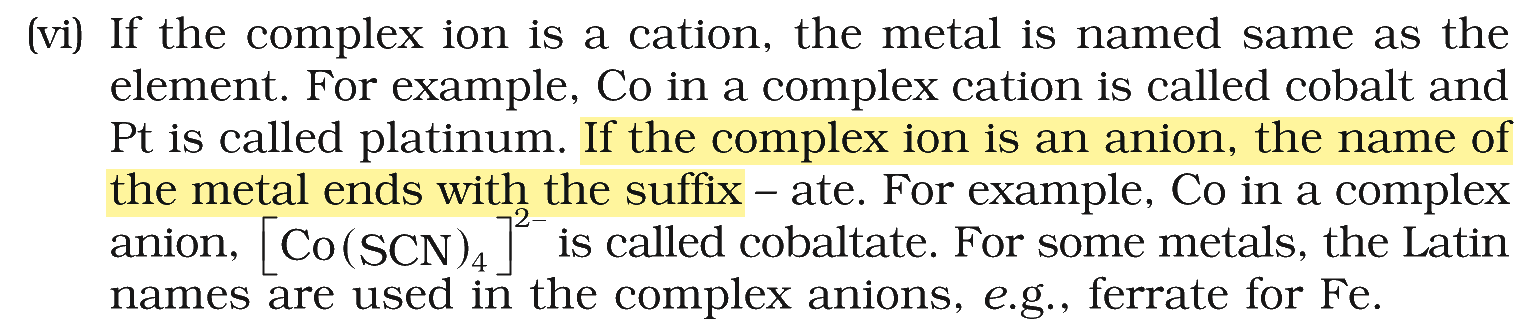
Textbook extract

Advertisement

Practise more on Inorganic: Coordination Compounds

Chapter-wise mocks on the real NTA exam screen, with solutions and your rank. Your first mocks are free.

Start free mocks →

Advertisement

Next questions

  1. Select the most appropriate ANTONYM of the given word. SabotageEnglish · Antonyms
  2. The value of elements of the balance of payments are given as:Exports: ₹150 millionImports: ₹240 millionInvisibles: ₹52 millionNon-factor S…Economics · Macro Economics: Open Economy Macro Economics
  3. Select the option that can be used as a one-word substitute for the given group of words. Showing great attention to detail and correct beh…English · One Word
  4. A certain antibiotic 'X' is effective only against a few types of harmful microbes and cells. What is the antibiotic 'X'?Chemistry · Organic: Chemistry in Everyday Life
  5. Which of the followingis NOT true about Right to Religion in India?General Aptitude Test · General Knowledge
  6. The __________ came to be known as the Dutch Palace.General Aptitude Test · General Knowledge
  7. What is the role of emulsifiers?Chemistry · Physical: Surface Chemistry
  8. On introducing a thin sheet if thickness 2 × 10⁻⁶ m and refractive index 1.5 in the path of one of the waves, central bright maxima shifts…Physics · Wave Optics
  9. Match List-I with List-IIList-IList-II(A)The Lucknow Pact(I)1915(B)The Muslim League(II)1940(C)The Hindu Mahasabha(III)1906(D)The Pakistan…History · Modern India: Understanding Partition
  10. Choose the correct meaning of the following idioms: At daggers drawnGeneral Aptitude Test · General Ability