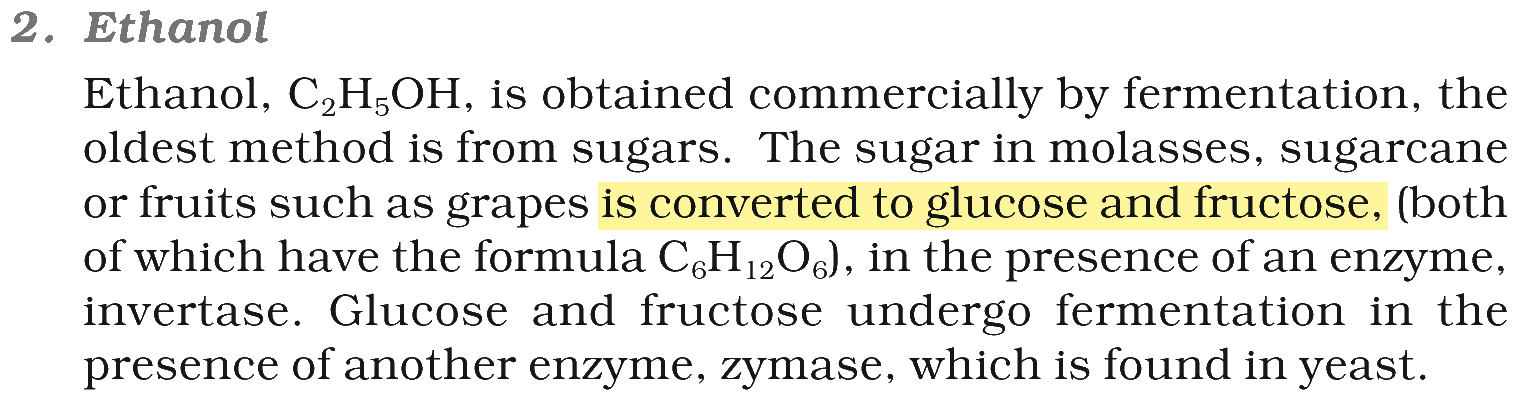
Ethanol is commercially obtained from sugar present in molasses according to the following reactions.
\( \displaystyle \ce{C12H22O11 + H2O} \xrightarrow{\text{A}} \text{X + Y} \)
\( \displaystyle \ce{C6H12O6} \xrightarrow{\text{B}} \text{Z} + \ce{2CO2} \)
Which of the following options from the table is correct?
Answer & explanation
Correct answer: option 2
The correct answer is Option (2) → X = Glucose, Y = Fructose, Z = Ethanol, A = Invertase, B = Zymase
Two enzymes from yeast act one after the other:
Invertase (enzyme A) hydrolyses sucrose into glucose and fructose (X and Y):
\( \displaystyle \ce{C12H22O11 + H2O} \xrightarrow{\text{Invertase}} \underset{\text{glucose}}{\ce{C6H12O6}} + \underset{\text{fructose}}{\ce{C6H12O6}} \)
Zymase (enzyme B) converts glucose and fructose into ethanol (Z) and carbon dioxide:
\( \displaystyle \ce{C6H12O6} \xrightarrow{\text{Zymase}} \ce{2C2H5OH + 2CO2} \)
One mole of hexose gives two moles of ethanol, so Z is ethanol.
So X = glucose, Y = fructose, Z = ethanol, A = invertase and B = zymase.
Why the other options are incorrect
Option (1) (X = Y = glucose, Z = methanol, A = invertase, B = zymase) — Incorrect. Sucrose gives one glucose and one fructose, and fermentation gives ethanol, not methanol.
Option (3) (X = Y = fructose, Z = ethanol, A = zymase, B = invertase) — Incorrect. The enzymes are swapped; invertase acts first on sucrose, and the products are glucose and fructose.
Option (4) (X = Y = fructose, Z = methanol, A = zymase, B = invertase) — Incorrect. The enzymes are swapped, the hydrolysis products are wrong, and methanol is not a fermentation product.
NCERT (2026-27 edition):
Ethanol