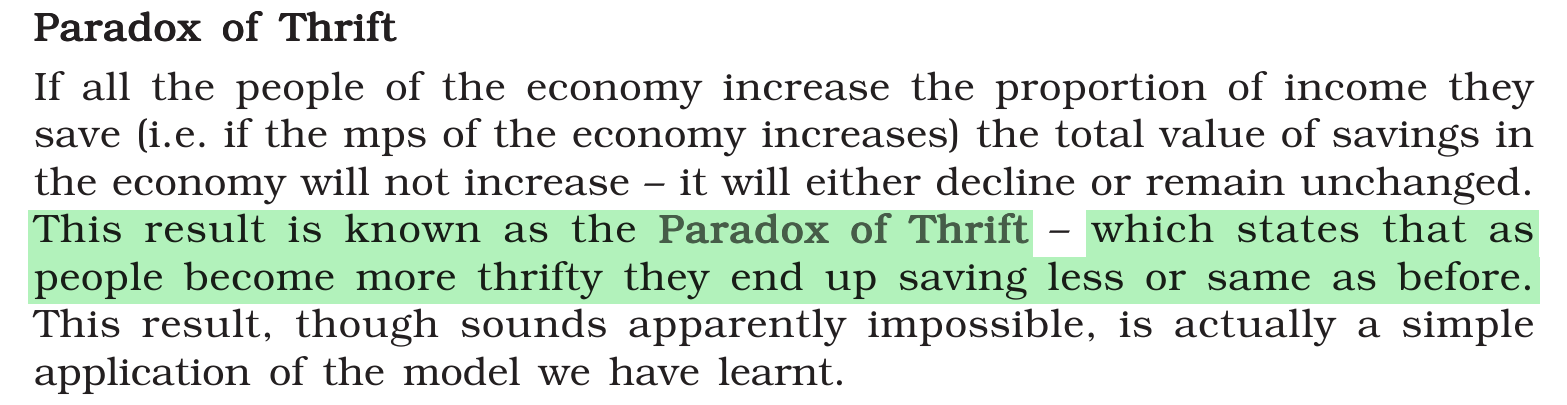
If all the people of the economy increase the proportion of income they save, the total value of savings in the economy will not increase - it will either decline or remain unchanged. This result is known as the___.
Answer & explanation
Correct answer: option 3
The correct answer is Option (3) → Paradox of Thrift
For one family, saving more is wise. But when all the people of the economy try to save a larger share of their income at the same time, the total saving of the economy does not increase: it stays the same or falls. A virtue for each household brings no gain to the economy as a whole, and this result is the paradox of thrift.
It comes from the way spending and income are linked:
Every household saves more, so consumption expenditure falls and aggregate demand falls with it.
Through the multiplier, equilibrium income falls by more than the original cut in consumption.
In equilibrium saving must equal planned investment, and investment is autonomous, fixed independently of income, so the economy ends up saving what it was saving before.
If investment itself falls as income falls, total saving ends up smaller than before.
Why the other options are incorrect
Option (1) Paradox of Shift — Incorrect. There is no such term.
Option (2) Parametric Shift — Incorrect. A parametric shift is the shift of a line when one of its parameters, its slope or its intercept, changes, as when the aggregate demand line moves up after a rise in autonomous spending. It describes a graph, not the result about saving.
Option (4) Parametric Thrift — Incorrect. There is no such term.
Note: A similar question was also asked in CUET (UG) 2026 on 11-05-2026 (Slot 1), 13-05-2026 (Slot 1), 21-05-2026 (Slot 1) and 07-06-2026 (Slot 2).
NCERT: Introductory Macroeconomics — Chapter 4: Determination of Income and Employment (2025-26)
|