Which one of the following is not the main objective of NITI Aayog?
A. To evolve a shared vision of national development
B. To foster cooperative federation
C. To design long term policy
D. To monitor and evaluate the implementation of programmes
E. To formulate foreign policy
Choose the correct answer from the options given below:
Answer & explanation
Correct answer: option 4
The correct answer is Option (4) → E only
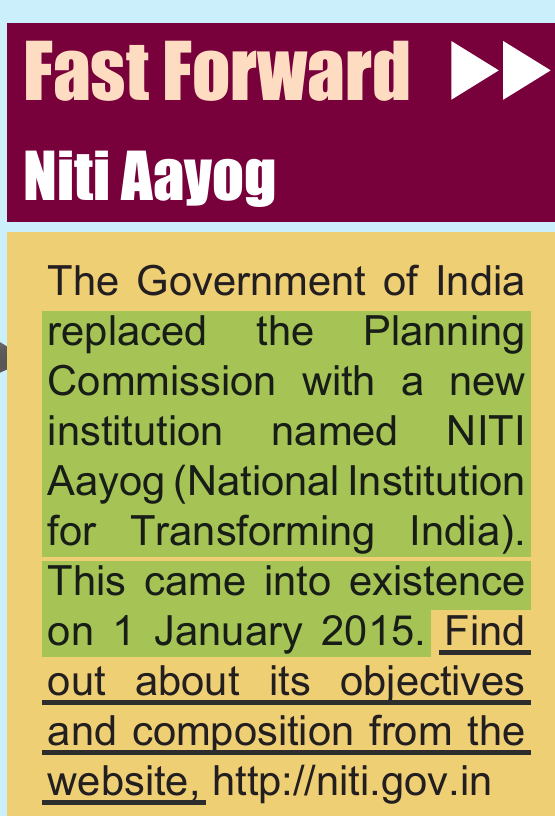
NITI Aayog (National Institution for Transforming India) replaced the Planning Commission on 1 January 2015. Like the Planning Commission, it is a body for planning and development, not for relations with other countries.
A. To evolve a shared vision of national development An objective (Incorrect). NITI Aayog works out national development priorities together with the States, so that the Centre and the States share one vision.
B. To foster cooperative federation An objective (Incorrect). It brings the States into policy making through structured support and regular consultation, in the spirit of cooperative federalism.
C. To design long term policy An objective (Incorrect). It works as the think tank of the government and designs long-term strategic policy and programme frameworks.
D. To monitor and evaluate the implementation of programmes An objective (Incorrect). It watches how government programmes are carried out and judges their results, so that they can be improved.
E. To formulate foreign policy Not an objective (Correct). Foreign policy is made by the Union government through the Ministry of External Affairs; it is no part of the work of a planning and development body.
Note: The NCERT books (2023-24, 2025-26 and 2026-27) say only that the Planning Commission was replaced by NITI Aayog, which came into existence on 1 January 2015, and ask the student to find out its objectives from its website; the pre-rationalised NCERT does not mention NITI Aayog. The objectives of NITI Aayog are not in any NCERT book; they are explained here for the benefit of the students.
NCERT (2026-27): Politics in India since Independence — Chapter 3: Politics of Planned Development
|