Haloarenes undergo the usual electrophilic reactions of the benzene ring such as halogenation, nitration, sulphonation and Friedel-Crafts reactions. Halogen atom besides being slightly deactivating is o, p-directing; therefore, further substitution occurs at ortho- and para-positions with respect to the halogen atom. The o, p-directing influence of halogen atom can be easily understood if we consider the resonating structures of halobenzene as shown:
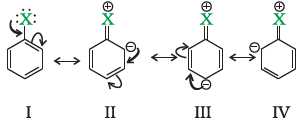 Due to resonance, the electron density increases more at ortho- and para-positions than at meta-positions. Further, the halogen atom because of its –I effect has some tendency to withdraw electrons from the benzene ring. As a result, the ring gets somewhat deactivated as compared to benzene and hence the electrophilic substitution reactions in haloarenes occur slowly and require more drastic conditions as compared to those in benzene.
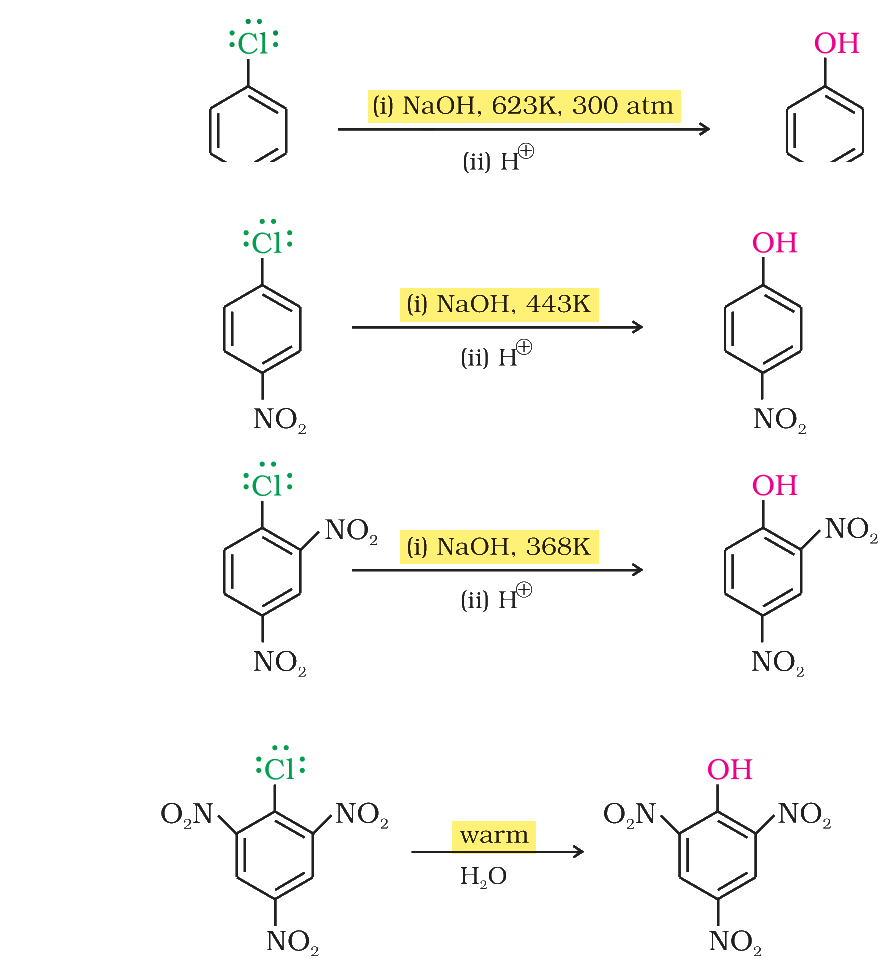
Each haloarene in List-I is converted into the corresponding phenol. Match the haloarene with the conditions needed for this conversion, given in List-II.
| List-I (Haloarene) | List-II (Conditions) |
|---|---|
| (A) Chlorobenzene | (I) Warm water |
| (B) 1-Chloro-4-nitrobenzene | (II) (i) NaOH, 443 K; (ii) H+ |
| (C) 1-Chloro-2,4-dinitrobenzene | (III) (i) NaOH, 623 K, 300 atm; (ii) H+ |
| (D) 2-Chloro-1,3,5-trinitrobenzene | (IV) (i) NaOH, 368 K; (ii) H+ |
Choose the correct answer from the options given below:
Answer & explanation
Correct answer: option 4
The correct answer is Option (4) → A-III, B-II, C-IV, D-I
Chlorobenzene resists nucleophilic substitution, so it needs very drastic conditions. An electron withdrawing –NO2 group at the ortho- or para-position pulls electron density out of the ring, makes the attack of the nucleophile easier and stabilises the carbanion formed by resonance. So, the more such nitro groups, the milder the conditions needed.
(A) Chlorobenzene — This matches (III) (i) NaOH, 623 K, 300 atm; (ii) H+. With no nitro group, the reaction needs a high temperature and a very high pressure:
\( \displaystyle \ce{C6H5Cl} \xrightarrow[\text{(ii) } \ce{H+}]{\text{(i) NaOH, 623 K, 300 atm}} \ce{C6H5OH} \)
(B) 1-Chloro-4-nitrobenzene — This matches (II) (i) NaOH, 443 K; (ii) H+. One nitro group para to chlorine lowers the temperature needed, and the product is 4-nitrophenol:
\( \displaystyle \ce{O2N-C6H4-Cl} \xrightarrow[\text{(ii) } \ce{H+}]{\text{(i) NaOH, 443 K}} \ce{O2N-C6H4-OH} \)
(C) 1-Chloro-2,4-dinitrobenzene — This matches (IV) (i) NaOH, 368 K; (ii) H+. With nitro groups at both the ortho- and the para-position, the reaction goes at a still lower temperature, giving 2,4-dinitrophenol:
\( \displaystyle \ce{(O2N)2C6H3-Cl} \xrightarrow[\text{(ii) } \ce{H+}]{\text{(i) NaOH, 368 K}} \ce{(O2N)2C6H3-OH} \)
(D) 2-Chloro-1,3,5-trinitrobenzene — This matches (I) Warm water. With nitro groups at both ortho-positions and the para-position, even warm water replaces the chlorine, giving 2,4,6-trinitrophenol:
\( \displaystyle \ce{(O2N)3C6H2-Cl} \xrightarrow{\text{warm } \ce{H2O}} \ce{(O2N)3C6H2-OH} \)
NCERT (2026-27 edition):
6.7.2 Reactions of Haloarenes – “Chlorobenzene can be converted into phenol by heating in aqueous sodium hydroxide solution at a temperature of 623K and a pressure of 300 atmospheres.”
“The presence of an electron withdrawing group (-NO2) at ortho- and para-positions increases the reactivity of haloarenes.”
“…As shown, the presence of nitro group at ortho- and para-positions withdraws the electron density from the benzene ring and thus facilitates the attack of the nucleophile on haloarene. The carbanion thus formed is stabilised through resonance.”