
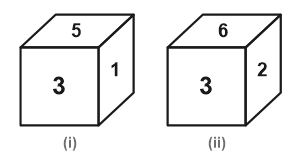
One cube is drawn below in two different ways. Which paper pattern, folded along its lines, makes this cube?
Answer & explanation
Correct answer: option 4
The correct answer is Option (4) →
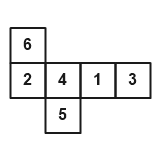
Faces seen together in a picture are neighbours, so the right sheet must never make two of them opposite. On a sheet, two squares in a straight line with one square between them become opposite faces, and the two squares on either side of the row or column of four are opposite too.
The pictures show these neighbours: 1 and 3, 1 and 5, 2 and 3, 2 and 6, 3 and 5, and 3 and 6.
In sheet (4), coloured below, the opposite pairs are:
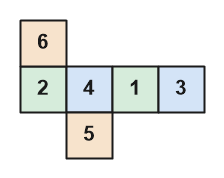
2 and 1 (one square between them in the row)
4 and 3 (one square between them in the row)
6 and 5 (on the two sides of the row of four)
None of these pairs is seen together, and folding sheet (4) gives both pictures.
Why the other options are incorrect
Option (1) — Incorrect. This sheet makes 2 and 6 opposite (one square between them in the row), but picture (ii) shows them side by side.
Option (2) — Incorrect. This sheet makes 3 and 1 opposite (one square between them in the row), but picture (i) shows them side by side.
Option (3) — Incorrect. This sheet makes 3 and 5 opposite (on the two sides of the column of four), but picture (i) shows them side by side.