Read the case study and answer question:
Radiant limited is a well known Pharmaceutical company. The company is planning to expand and modernize its business operations for which it requires 500 crores. Akshat, the finance manager of the company, advised to issue Equity Shares in the Capital market.
The Board finally decided to issue 300 crores through issue of Shares to general public electronically in the primary market. For the remaining 200 crores, the company will give a privilege to existing shareholders to subscribe to new shares as per the conditions of Radiant limited.
In order to meet floatation cost, for raising funds in the capital market the company decided to issue a money market instrument. Further the company will get the shares listed in the secondary market. Listing with stock exchange will facilitate buying and selling of securities and provide safety of investment to the investors.
Which money market instrument will be issued by Radiant limited for meeting floatation cost?
Answer & explanation
Correct answer: option 4
The correct answer is Option (4) → Commercial paper
Option (1) Treasury Bill — Incorrect. A Treasury bill is issued by the Reserve Bank of India for the Government of India. A company cannot issue it.
Option (2) Certificate of Deposit — Incorrect. Certificates of deposit are issued by commercial banks and development financial institutions, not by a company like Radiant Limited.
Option (3) Call money — Incorrect. Call money is very short-term borrowing (one to fifteen days) between banks.
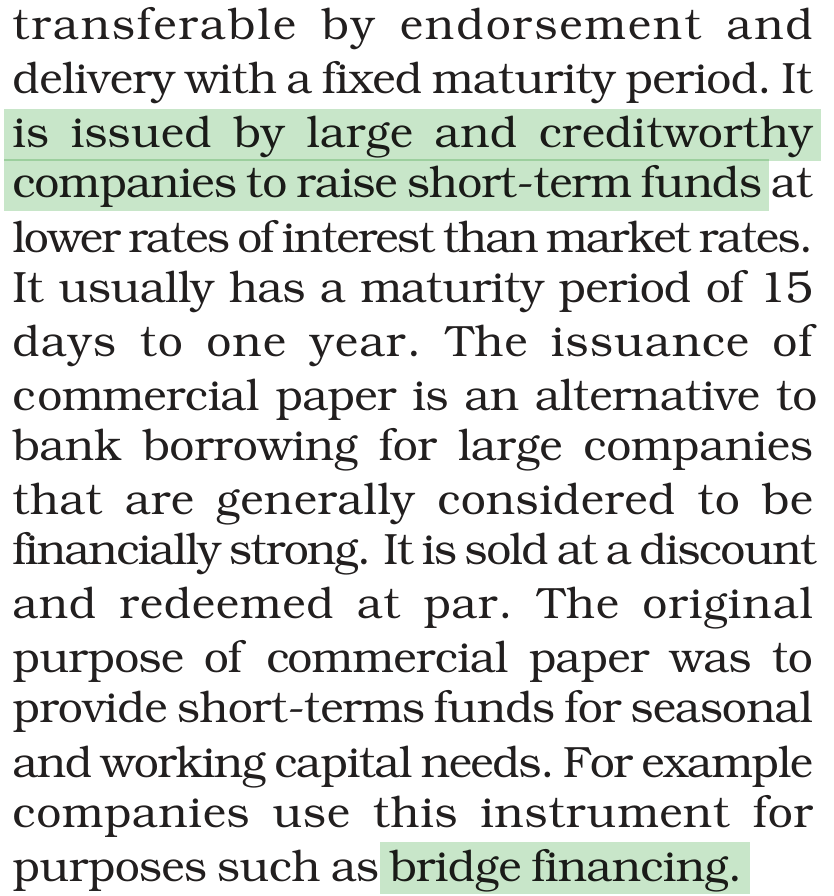
Option (4) Commercial paper — Correct. Commercial paper is a short-term unsecured promissory note issued by large and creditworthy companies. When a company raises long-term funds, it has to pay floatation costs such as brokerage, commission, printing and advertising. Funds raised through commercial paper are used to meet these costs. This is called bridge financing.
Note: Although the chapter ‘Financial Markets’ was dropped from the NCERT textbooks during rationalisation, it has stayed in the NTA syllabus every year since 2022, except for 2025, and it is part of the syllabus again from 2026. This question is therefore based on the pre-rationalised NCERT, an extract from which is given below. NCERT (Pre-rationalised Edition): “Example: Suppose a company needs long-term finance to buy some machinery. In order to raise the long term funds in the capital market the company will have to incur floatation costs (costs associated with floating of an issue are brokerage, commission, printing of applications and advertising etc.). Funds raised through commercial paper are used to meet the floatation costs. This is known as Bridge Financing.”
|