Nucleosome is:
Answer & explanation
Correct answer: option 2
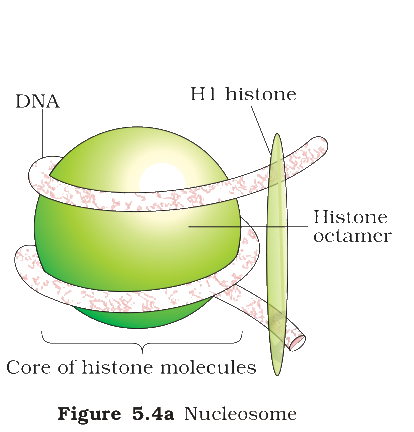
The correct answer is Option (2) → Negatively charged DNA wrapped around positively charged histone octamer
DNA carries a negative charge because of the phosphate groups in its backbone. Histones carry a positive charge because they are rich in lysine and arginine. Opposite charges attract, and this holds the DNA round the histones.
Option (1) Positively charged DNA wrapped around negatively charged histone octamer — Incorrect. Both charges are reversed. DNA is negative and histones are positive.
Option (2) Negatively charged DNA wrapped around positively charged histone octamer — Correct. A typical nucleosome holds about 200 bp of DNA. Nucleosomes are the repeating units of chromatin, seen as ‘beads-on-string’.
Option (3) Positively charged DNA wrapped around positively charged histone octamer — Incorrect. DNA is not positive. Besides, two positive charges would repel, and no nucleosome could form.
Option (4) Negatively charged DNA wrapped around negatively charged histone octamer — Incorrect. The DNA is right, but histones are basic, positive proteins. Two negative charges would also repel.
Note: A similar question was also asked in CUET (UG) 2025 on 22-05-2025 (Slot 1).
NCERT Extract:
Packaging of DNA Helix – “… In eukaryotes, this organisation is much more complex. There is a set of positively charged, basic proteins called histones. A protein acquires charge depending upon the abundance of amino acids residues with charged side chains. Histones are rich in the basic amino acid residues lysine and arginine. Both the amino acid residues carry positive charges in their side chains. Histones are organised to form a unit of eight molecules called histone octamer. The negatively charged DNA is wrapped around the positively charged histone octamer to form a structure called nucleosome (Figure 5.4 a).”