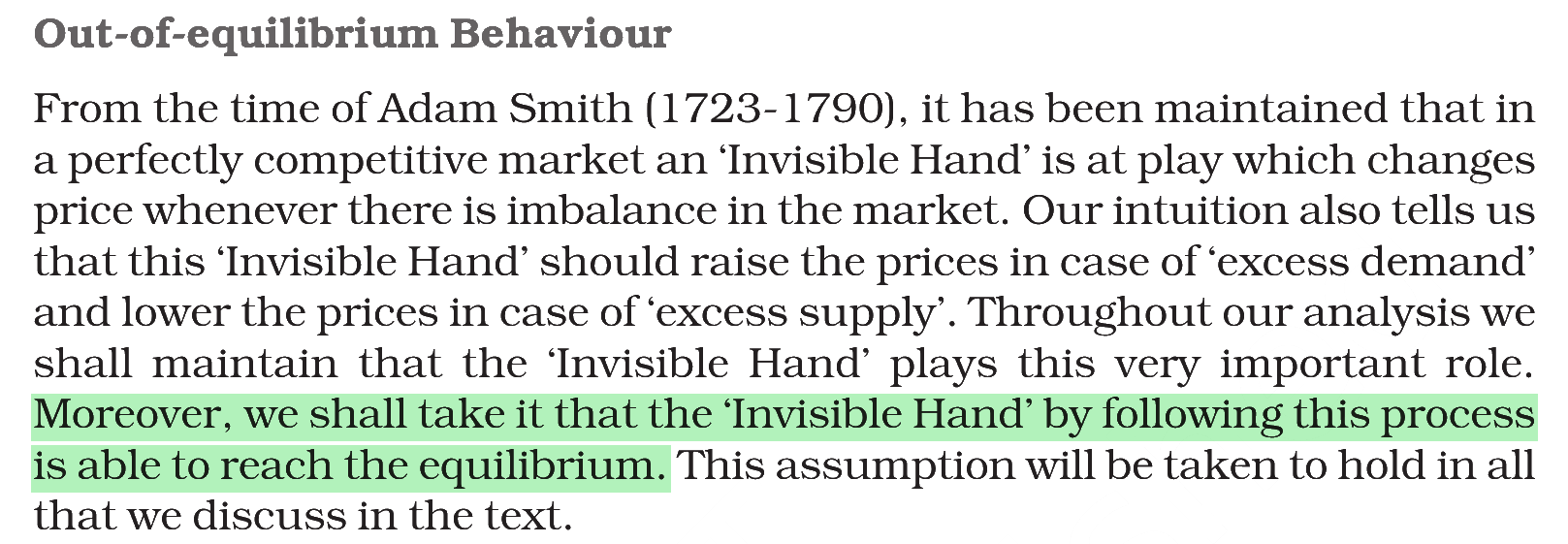
Excess demand and excess supply can be adjusted by the invisible hand to reach the ________________ .
Answer & explanation
Correct answer: option 2
The correct answer is Option (2) → Equilibrium
In a market, buyers decide how much to buy and sellers how much to sell, each at the going price. When the two plans do not match, the market is in disequilibrium, and there are two cases:
Excess demand: at the going price buyers want more than sellers offer. Buyers who are left out offer more, so the price rises; this cuts the quantity demanded and raises the quantity supplied.
Excess supply: sellers offer more than buyers want. With goods left unsold, sellers cut the price, so the price falls; this raises the quantity demanded and cuts the quantity supplied.
Either way the gap narrows until quantity demanded equals quantity supplied, which is equilibrium. Nobody directs this adjustment; the market sorts itself out as if an ‘Invisible Hand’ were at work, in Adam Smith’s phrase.
Why the other options are incorrect
Option (1) Disequilibrium — Incorrect. Disequilibrium is the starting point, the imbalance the invisible hand removes, not the state it leads to.
Option (3) Substitution effect — Incorrect. A term from consumer theory: the change in the quantity demanded of a good when its price changes, because it becomes cheaper or dearer relative to other goods. It explains a buyer’s response, not where the market settles.
Option (4) Income effect — Incorrect. Also from consumer theory: the change in quantity demanded because a price change alters the consumer’s real income. Like Option (3), it is not the state the market reaches.
NCERT: Introductory Microeconomics — Chapter 5: Market Equilibrium (2025-26)
|