The statements below are about Gaganendranath Tagore and Nandalal Bose. Consider the following statements:
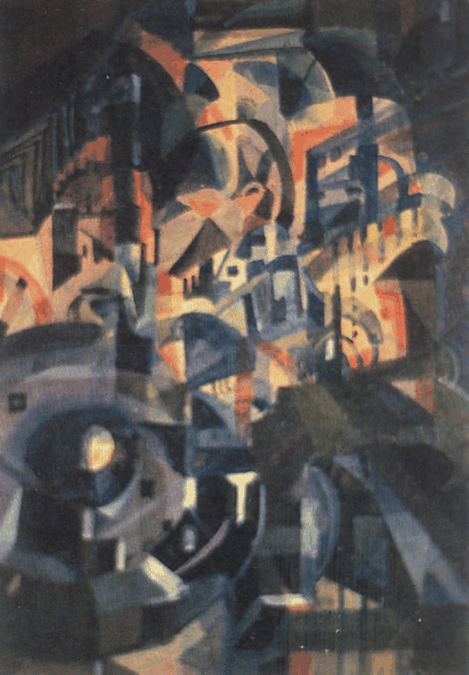
(A) In City in the Night, Gaganendranath transformed the static geometry of Analytical Cubism into an expressive apparatus.
(B) Gaganendranath softened Cubism’s formal geometry with a profile, shadow or outline of human form.
(C) Rabindranath Tagore invited Nandalal Bose to paint panels for the Congress session at Haripura.
(D) Gaganendranath visualised imaginary cities like Dwarka and Swarnapuri through the multiple viewpoints of Cubism.
Choose the correct answer from the options given below:
Answer & explanation
Correct answer: option 2
The correct answer is Option (2) → (A), (B) and (D) only
(A) In City in the Night, Gaganendranath transformed the static geometry of Analytical Cubism into an expressive apparatus. — Correct. He externalised inner turbulence through a blend of allegorical and formal, turning Analytical Cubism into an expressive apparatus.
(B) Gaganendranath softened Cubism’s formal geometry with a profile, shadow or outline of human form. — Correct. He softened the geometry with a seductive profile, shadow or outline of human form.
(C) Rabindranath Tagore invited Nandalal Bose to paint panels for the Congress session at Haripura. — Incorrect. Mahatma Gandhi invited Nandalal to paint the Haripura panels. Rabindranath invited him to head the painting department at Kala Bhavana.
(D) Gaganendranath visualised imaginary cities like Dwarka and Swarnapuri through the multiple viewpoints of Cubism. — Correct. He showed these imaginary cities through multiple viewpoints, multi-faceted shapes and jagged edges of Cubism.
NCERT (2026-27): “City in the Night This is a watercolour painting made by Gaganendranath Tagore (1869–1938) in 1922. He was one of the earlier Indian painters, who made use of language and syntax of Cubism to render his ideas. The inner experiences of turbulence are externalised through a blend of allegorical and formal, transforming the static geometry of Analytical Cubism into an expressive apparatus. He softened Cubism’s formal geometry with a seductive profile, shadow or outline of human form. He visualised the mysterious world of his imaginary cities like Dwarka (Lord Krishna’s legendary abode) or Swarnapuri (The Golden City) through multiple viewpoints, multi-faceted shapes and jagged edges of Cubism.”
“Shantiniketan — Early modernism Nandalal Bose, a student of Abanindranath Tagore, was invited by poet and philosopher Rabindranath Tagore to head the painting department in the newly established Kala Bhavana. … He also illustrated primers in Bengali with woodcuts and understood the role of art in teaching new ideas. For this reason, Mahatma Gandhi invited him to paint panels that were put on display at the Congress session at Haripura in 1937.” |