
CUETMOCK
  • Pricing
  • Mentors
Log inStart freeStart free mocks→

First test, then trust

Try a free CUET mock test.

Join 5,00,000+ students who rehearsed exam day on the exact NTA screen before sitting CUET. On the web and on Android.

Start free mocks →Get the Android app
CUETMOCK

India's #1 CUET Mock Test Platform. Original NCERT-based questions on the exact NTA exam screen — trusted by 5,00,000+ students since CUET 2022.

Get it onGoogle PlayScan to download the CUETMOCK app

Mock tests

  • CUET mock test series
  • Browse all papers
  • Commerce mocks
  • Humanities (Arts) mocks
  • Science mocks
  • Languages & GAT mocks
  • Free practice questions
  • Pricing

Resources

  • CUET exam guide
  • CUET syllabus
  • Universities accepting CUET
  • Expert blogs
  • News & notifications
  • Webinars & counselling
  • CUET score calculator
  • How we estimate your rank
  • FAQs

Company

  • About us
  • Our leadership & team
  • Our toppers
  • Mentors
  • For schools
  • Contact us
  • Terms
  • Privacy
  • Refund policy

Talk to us

+91 7696 6630 56info@cuetmock.comWhatsApp us

Our other platforms

  • JEE Mock — For IIT-JEE aspirants
  • NEET Mock — For NEET aspirants

Newsletter

Exam updates, study material and offers — no spam.

© 2026 NYC Ventures Pvt. Ltd.

701-702, Royal Business Park, Zirakpur, Punjab - 140603

  • Terms of use
  • Privacy policy
  • Refund policy
  • Contact us

iCUETMOCK is an independent preparation platform, not affiliated with the National Testing Agency (NTA). Always check exam details on the official NTA website.

  • Home
  • Mock tests
  • CUET guide
  • Pricing
  • Log in
Home/Practice questions/Fine Arts
Fine ArtsThe Deccani Schools of Painting

Which of the following statements is correct about Ragini Pathamsika…

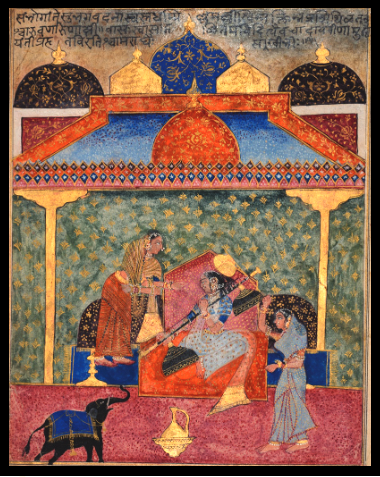
Which of the following statements is correct about Ragini Pathamsika of Raga Hindola painting of Deccan School?

A- It is an important member of the Ragamala family of the Indian musical mode, dates back to around 1590–95.

B- In the painting the centrally placed female musician is playing an Indian instrument, which appears to be a flute.
Choose the correct answer from the given options:
1- Only Statement 'A' is correct.
2- Only Statement 'B' is correct.
3- Both Statements are correct.
4- Both Statements are incorrect.

Answer & explanation+

Correct answer: option 1

The correct answer is option 1 - 1 (Only Statement 'A' is correct.)

Given statements about Ragini Pathamsika of Raga Hindola painting of Deccan School:

A- It is an important member of the Ragamala family of the Indian musical mode, dates back to around 1590–95.

B- In the painting the centrally placed female musician is playing an Indian instrument, which appears to be a flute.


An intriguing work in the collection of National Museum, New Delhi, titled Ragini Pathamsika of Raga Hindola, an important member of the Ragamala family of the Indian musical mode, dates back to around 1590–95. Some scholars believe it to be from Bijapur, an important state of Deccan. Painting was a highly developed art form in the Deccani states, almost simultaneous with the development of the Mughal School of Painting. Persian influence is obvious in the painting. This is seen in the arabesque decoration on the surface of the two domes that delineate the upper part of the painting, where letters written in Devanagari script cover the space. Two beautifully dressed and bejewelled women are seen in the pavilion, while the third is seen outside it. The centrally placed female musician is playing an Indian instrument, which appears to be veena, while the other two on the sides appear to be accompanying with rhythmic sway of their bodies. The colours are vibrant. Red is dominant and is complimented by green. The figures may be said to be stylised in the sense that the character of their physiology, including the face has been almost constructed on formulaic details. Nearly all forms are deeply emphasied with dark line. This is interestingly observable in the mural paintings of Ajanta, too, which were painted centuries ago. What is also to be noted here is a dark elephant in the left hand corner, with a raised trunk, a delightful sign of welcome. Small in scale, the elephant creates visual interest and breaks the architectonic structuring.

Advertisement

Practise more on The Deccani Schools of Painting

Chapter-wise mocks on the real NTA exam screen, with solutions and your rank. Your first mocks are free.

Start free mocks →

Advertisement

Next questions

  1. Currency notes and coins cannot be refused by any citizen of the country for settlement of any kind of transaction due to which they are ca…Economics · Macro Economics: Money and Banking
  2. Pranjal takes twice as much time as Vikram or thrice as much time as Ashwin to finish a piece of work. Working together, they can finish th…General Aptitude Test · Numerical Ability
  3. From the given options, select the correctly spelt word:English · Spelling Check
  4. How many triangles are there in the given figure?General Aptitude Test · Verbal Reasoning
  5. To construct a quadrilateral, we need to know two diagonals and _____ sides.General Aptitude Test · Quantitative Reasoning
  6. S. H. Raza moved in the direction of abstraction. Which element did he use in some paintings as a symbol of oneness from Indian philosophy?Fine Arts · The Modern Indian Art
  7. Select the correct option that indicates the arrangement of the given words in the order in which they appear in an English dictionary. 1.…General Aptitude Test · Verbal Reasoning
  8. The 840 workers of a factory are numbered 1 to 840. A systematic random sample of 35 workers is drawn, and the first worker selected is wor…Applied Maths. Section B2 · Inferential Statistics
  9. A square piece of paper is folded as shown by the dotted line and the arrow, and the folded paper is punched as shown in the last figure. C…General Aptitude Test · Non-Verbal Reasoning
  10. A manufacturing unit makes two models, 'classic' and 'supreme' of the scooter. Each piece of the classic model requires 9 labour hours for…Applied Maths. Section B2 · Linear Programming