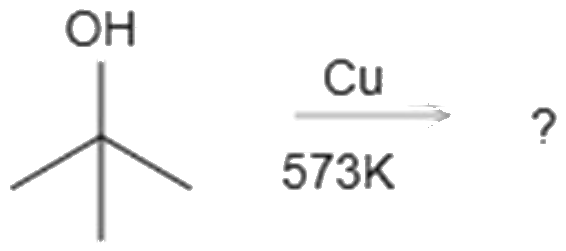
The major product of the following reaction is
Answer & explanation
Correct answer: option 3
The correct answer is Option (3) → 2-methylprop-1-ene.
When an alcohol vapour is passed over copper heated to about 573 K, the result depends on whether the carbon carrying the –OH group still has a hydrogen atom:
Primary alcohol → aldehyde (loses \( \ce{H2} \))
\( \displaystyle \ce{RCH2OH} \xrightarrow[\text{573 K}]{\ce{Cu}} \ce{RCHO + H2} \)
Secondary alcohol → ketone (loses \( \ce{H2} \))
\( \displaystyle \ce{R2CHOH} \xrightarrow[\text{573 K}]{\ce{Cu}} \ce{R2CO + H2} \)
Tertiary alcohol → alkene (loses \( \ce{H2O} \))
A tertiary alcohol has three alkyl groups and no hydrogen on the carbon carrying the –OH group, so it cannot lose \( \ce{H2} \). Instead, copper removes water.
The compound in the question is 2-methylpropan-2-ol (tert-butyl alcohol), a tertiary alcohol. The –OH group leaves together with a hydrogen atom from a neighbouring methyl group:
\( \displaystyle \ce{(CH3)3C-OH} \xrightarrow[\text{573 K}]{\ce{Cu}} \ce{(CH3)2C=CH2 + H2O} \)
The longest chain containing the double bond has three carbons, with a methyl branch on C-2. So the product is 2-methylprop-1-ene.
Note: It seems that there is a mistake in the original NTA paper. Option (2) is printed as “2-methylprop-2-ene”; this is not a valid name, because in a three carbon chain the double bond must be numbered from C-1, so the only possible name is 2-methylprop-1-ene.
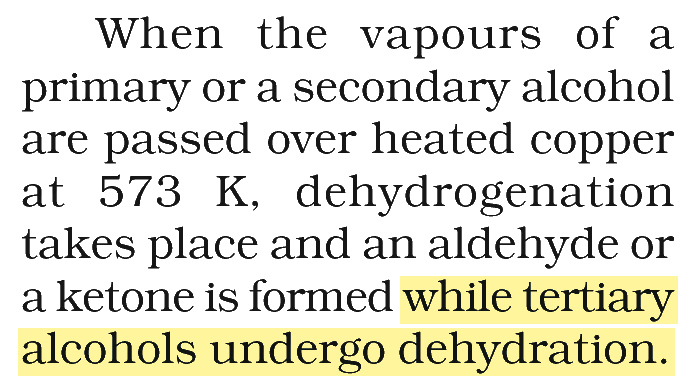
NCERT (2026-27 edition):
Chemical Reactions – …