Read the passage carefully and answer the Questions.
Carboxylic acids are the earliest organic compounds isolated from nature. These are also known as organic acids but are weaker acids as compared to mineral acids. However, they are more acidic than alcohols and phenols because of greater resonance stabilization of the parent acid and its conjugate base. The acidic strength is determined by the Ka, which is called the acidity constant. The greater the value of Ka, the greater the tendency of the acid to ionize and hence the stronger the acid. The acidic strength of the saturated aliphatic carboxylic acid depends upon the inductive effect and its position with respect to - COOH groups. Electron-donating substituents tend to decrease whereas electron -withdrawing substituents tend to increase the acidic strength. The acidic strength of the aromatic carboxylic acid, on the other hand depends upon both the inductive effect and the resonance effect of the substituents.
p-Nitrobenzoic acid is a stronger acid than benzoic acid because of
Answer & explanation
Correct answer: option 1
The correct answer is Option (1) → -R and -I effect of nitro group
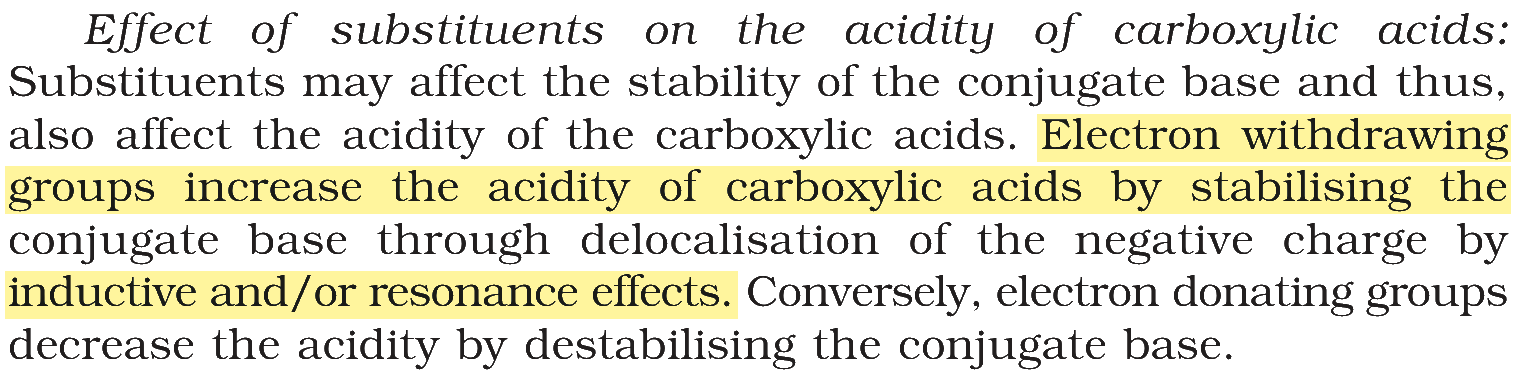
A carboxylic acid is stronger when its conjugate base, the carboxylate ion, is more stable. A substituent that pulls electron density away spreads the negative charge of the carboxylate ion and so stabilises it; a substituent that pushes electrons in does the opposite. The pull can act through the sigma bonds (the −I, inductive effect) or through the pi system of the ring (the −R, resonance effect).
The nitro group does both. Its nitrogen carries a positive formal charge and is bonded to two electronegative oxygen atoms, so it withdraws electrons through the sigma bonds (−I). Its N=O bonds are also conjugated with the benzene ring, so it withdraws pi electrons from the ring by resonance (−R); from the para position this pull reaches the ring carbon that carries the –COOH group.
\( \displaystyle \ce{O2N-C6H4-COOH + H2O <=> O2N-C6H4-COO- + H3O+} \)
Both effects stabilise the p-nitrobenzoate ion, so p-nitrobenzoic acid (pKa = 3.41) is stronger than benzoic acid (pKa = 4.19).
Why the other options are incorrect
Option (2) Only -R effect of Nitro group — Incorrect. The nitro group is strongly electronegative as well, so its −I effect also operates; resonance is not the only effect.
Option (3) Only -I effect of Nitro group — Incorrect. At the para position the nitro group is conjugated with the ring, so its −R effect adds to the inductive pull.
Option (4) +R effect and -I effect of nitro group — Incorrect. A +R group donates a lone pair into the ring, as –\( \ce{OCH3} \) or –OH do; the nitro group has no such lone pair to donate and withdraws electrons by resonance instead.
NCERT (2026-27 edition):
Effect of Substituents on the Acidity of Carboxylic Acids