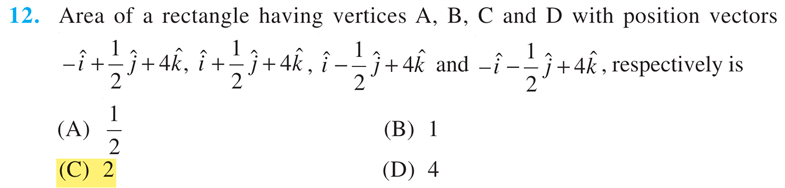
Area of a rectangle having vertices P, Q, R and S with position vectors \(-\hat{\imath}+\displaystyle\frac{1}{2}\hat{\jmath}+4\hat{k}\), \(\hat{\imath}+\displaystyle\frac{1}{2}\hat{\jmath}+4\hat{k}\), \(\hat{\imath}-\displaystyle\frac{1}{2}\hat{\jmath}+4\hat{k}\) and \(-\hat{\imath}-\displaystyle\frac{1}{2}\hat{\jmath}+4\hat{k}\) respectively is:
Answer & explanation
Correct answer: option 2
The correct answer is Option (2) → 2
Two adjacent sides of the rectangle are PQ and QR. Each side vector is the position vector of its end point minus that of its starting point:
\(\overrightarrow{PQ} = (1 - (-1))\hat{\imath} + 0\,\hat{\jmath} + 0\,\hat{k} = 2\hat{\imath}\)
\(\overrightarrow{QR} = 0\,\hat{\imath} + \left(-\frac{1}{2} - \frac{1}{2}\right)\hat{\jmath} + 0\,\hat{k} = -\hat{\jmath}\)
The area of the rectangle is the magnitude of the cross product of two adjacent sides:
\(\overrightarrow{PQ}\times\overrightarrow{QR} = 2\hat{\imath}\times(-\hat{\jmath}) = -2\hat{k}\)
\(\text{Area} = |-2\hat{k}| = 2\)
(The sides have lengths 2 and 1 and are perpendicular, so length × breadth = 2 × 1 = 2 as well.)
NCERT (2026-27 edition):
Product of Two Vectors