
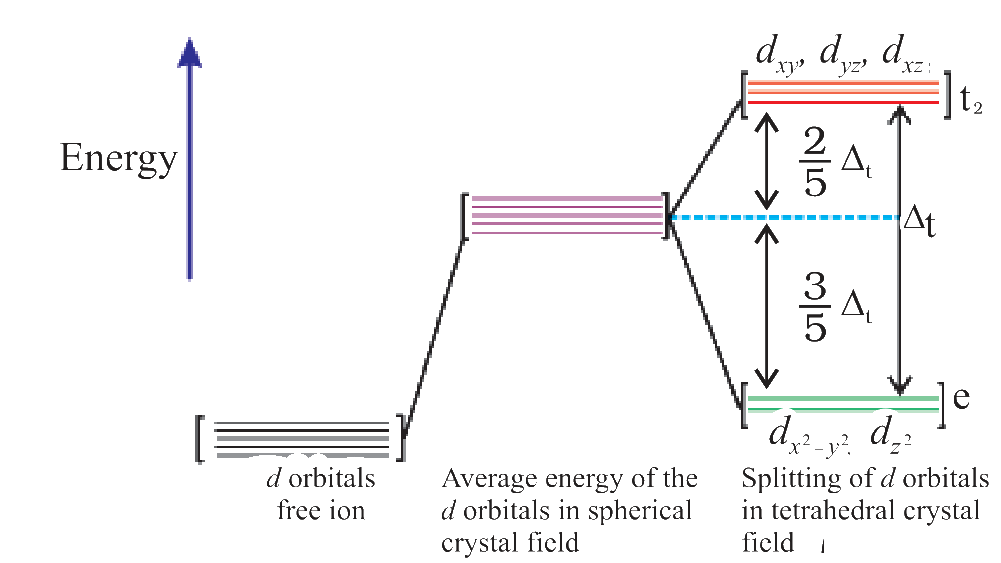
The figure shows the splitting of the d orbitals of a metal ion in a tetrahedral crystal field.
In a tetrahedral complex of a metal ion with a single d electron (d1), which set of d orbitals holds this electron in the ground state?
Answer & explanation
Correct answer: option 2
The correct answer is Option (2) → The e set, which is lowered by (3/5)Δt below the average energy
In the ground state an electron occupies the lowest energy level available. In a tetrahedral field the splitting is inverted compared with the octahedral field, so the lower level is the set of two orbitals.
Reading the figure — the upper set of three orbitals (dxy, dyz, dxz) is t2, raised by (2/5)Δt; the lower set of two orbitals (dx2−y2, dz2) is e, lowered by (3/5)Δt.
The d1 electron — goes into the e set, the lower one, (3/5)Δt below the average energy.
Why the other options are incorrect
Option (1) The t2 set, which is raised by (2/5)Δt above the average energy — Incorrect. The t2 set is the higher level. A single electron in its ground state takes the lower e set.
Option (3) The e set, which is lowered by (2/5)Δt below the average energy — Incorrect. The set is right, but the figure marks the fall of the e set as (3/5)Δt; (2/5)Δt is the rise of the t2 set.
Option (4) The t2 set, which is lowered by (3/5)Δt below the average energy — Incorrect. In a tetrahedral field the t2 set is raised, not lowered. It is in the octahedral field that the set of three orbitals (t2g) lies lower.
NCERT (2026-27 edition):
5.5.4 Crystal Field Theory – “In tetrahedral coordination entity formation, the d orbital splitting (Fig. 5.9) is inverted and is smaller as compared to the octahedral field splitting.”
5.5.5 Colour in Coordination Compounds – “This is an octahedral complex where the single electron (Ti3+ is a 3d1 system) in the metal d orbital is in the t2g level in the ground state of the complex. The next higher state available for the electron is the empty eg level.”
Fig. 5.9: d orbital splitting in a tetrahedral crystal field.