
In order to supplement daily diet, a person wishes to take tablets of types X and Y. The contents (in milligrams per tablet) of iron, calcium and vitamins in X and Y tablets are given as below:
|
Tablets |
Iron |
Calcium |
Vitamins |
|
X |
6 |
3 |
2 |
|
Y |
2 |
3 |
4 |
The person needs to supplement atleast 18 milligrams of iron, 21 milligrams of calcium and 16 milligrams of vitamins. The price of each tablet of X and Y is ₹2 and ₹1 respectively. How many tablets of each type should the person take in order to meet the above requirements at the minimum cost? Make an LPP and solve it graphically using iso-profit/iso-cost method.
Answer & explanation
Correct answer: option 4
The correct answer is Option (4) → 1 tablet of X and 6 tablets of Y for a minimum cost of ₹8.
Let the person take x tablets of type X and Y tablets of type Y daily and Z (in ₹) be the total cost of both types of tablets then $Z = 2x + 1.y = 2x+y$. The problem can be formulated as an LPP as follows:
Minimise $Z = 2x + y$ Subject to constraints
$6x + 2y ≥18$ i.e. $3x + y ≥9$ (iron constraint)
$3x + 3y ≥21$ i.e. $x+y≥7$ (calcium constraint)
$2x+4y≥ 16$ i.e. $x + 2y ≥8$ (vitamins constraint)
$x≥0, y ≥0$ (non-negativity constraints)
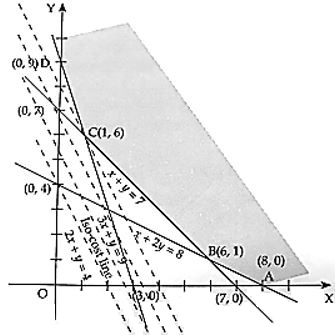
Draw the lines $3x + y = 9, x + y = 7$ and $x + 2y = 8$ and shade the region satisfied by the above inequalities. The feasible region (unbounded, convex) is shown shaded. The corner points are A(8, 0), B(6, 1), C(1, 6) and D(0,9).
Now, let us give some convenient value to Z say 4 and draw a dotted line $2x + y = 4$ which is called iso-cost line. Move this iso-cost line parallel to itself. We observe that first it passes through the corner point C(1, 6) of the feasible region.
It means the corner point C(1, 6) is closest to the origin, which gives us the optimal solution $Z=2×1+6=8$
i.e. $Z=8$
So, we find that minimum value of Z occurs at C(1, 6) and minimum value = ₹8.
Hence, the minimum cost of the tablets is ₹8 when the person takes 1 tablet of type X and tablets of type Y to meet the requirements.