
CUETMOCK
  • Pricing
  • Mentors
Log inStart freeStart free mocks→

First test, then trust

Try a free CUET mock test.

Join 5,00,000+ students who rehearsed exam day on the exact NTA screen before sitting CUET. On the web and on Android.

Start free mocks →Get the Android app
CUETMOCK

India's #1 CUET Mock Test Platform. Original NCERT-based questions on the exact NTA exam screen — trusted by 5,00,000+ students since CUET 2022.

Get it onGoogle PlayScan to download the CUETMOCK app

Mock tests

  • CUET mock test series
  • Browse all papers
  • Commerce mocks
  • Humanities (Arts) mocks
  • Science mocks
  • Languages & GAT mocks
  • Free practice questions
  • Pricing

Resources

  • CUET exam guide
  • CUET syllabus
  • Universities accepting CUET
  • Expert blogs
  • News & notifications
  • Webinars & counselling
  • CUET score calculator
  • How we estimate your rank
  • FAQs

Company

  • About us
  • Our leadership & team
  • Our toppers
  • Mentors
  • For schools
  • Contact us
  • Terms
  • Privacy
  • Refund policy

Talk to us

+91 7696 6630 56info@cuetmock.comWhatsApp us

Our other platforms

  • JEE Mock — For IIT-JEE aspirants
  • NEET Mock — For NEET aspirants

Newsletter

Exam updates, study material and offers — no spam.

© 2026 NYC Ventures Pvt. Ltd.

701-702, Royal Business Park, Zirakpur, Punjab - 140603

  • Terms of use
  • Privacy policy
  • Refund policy
  • Contact us

iCUETMOCK is an independent preparation platform, not affiliated with the National Testing Agency (NTA). Always check exam details on the official NTA website.

  • Home
  • Mock tests
  • CUET guide
  • Pricing
  • Log in
Home/Practice questions/General Aptitude Test
General Aptitude TestQuantitative ReasoningData Interpretation & Stats

The given bar graph indicates the production of sugar (in lakh tonnes…

The given bar graph indicates the production of sugar (in lakh tonnes) by three different sugar companies P, Q and R from the year 2015 to 2019. Study the bar graph and answer the question that follows. Production of sugar by companies P, Q and R from 2015 to 2019
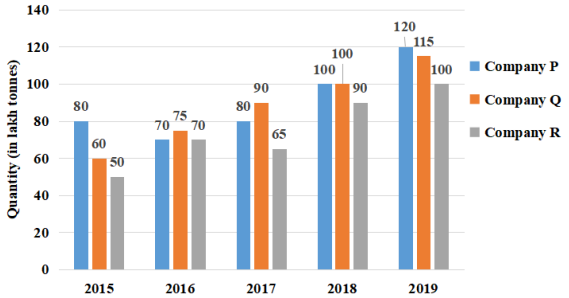
The percentage increase in the production of sugar by company P in 2019 as compared to 2015 is:

Answer & explanation+

Correct answer: option 1

Production of sugar by company P in 2015 = 80

Production of sugar by company P in 2019 = 120

Percentage increase in production = \(\frac{120-80 }{80}\) × 100

= \(\frac{40 }{80}\) × 100

= 50%


Advertisement

Practise more on Quantitative Reasoning

Chapter-wise mocks on the real NTA exam screen, with solutions and your rank. Your first mocks are free.

Start free mocks →

Advertisement

Next questions

  1. Choose the most appropriate option to fill in the blank:The power cut lasted so long ______ the ice cream in our freezer melted completely.English · Grammar: Conjunction
  2. What happens when phenol reacts with bromine water followed by NaHSO3?Chemistry · Organic: Alcohols, Phenols and Ethers
  3. The effect of globalisation in India can be identified as _______________.Sociology · Social Change and Development in India: Globalisation and Social Change
  4. Identify the odd one out among the following questions, judged by what sociologists of industrial society are interested in:Sociology · Social Change and Development in India: Change and Development in industrial Society
  5. If K1 and K2 are two distinct prime numbers, then what is the product of the highest common factor and the least common multiple of K1 and…General Aptitude Test · Numerical Ability
  6. Which of the following is used in organic farming?Economics · Indian Economic Development: Rural Development
  7. Choose the correct option that can replace the word 'CHAUVINIST'English · One Word
  8. How much amount is received on application by the company?Accountancy Part A · Issue and Redemption of Debentures
  9. Select the most appropriate synonym of the given word. REDUNDANTEnglish · Synonyms
  10. Arrange the following events (in relation to the issue of shares) in a logical order. (A) Transfer to capital reserve.(B) Forfeiture of sha…Accountancy Part A · Accounting for Shares