While charging the lead storage battery.......
Answer & explanation
Correct answer: option 1
The correct answer is Option (1) → \(PbSO_4\) on anode is reduced to \(Pb\)
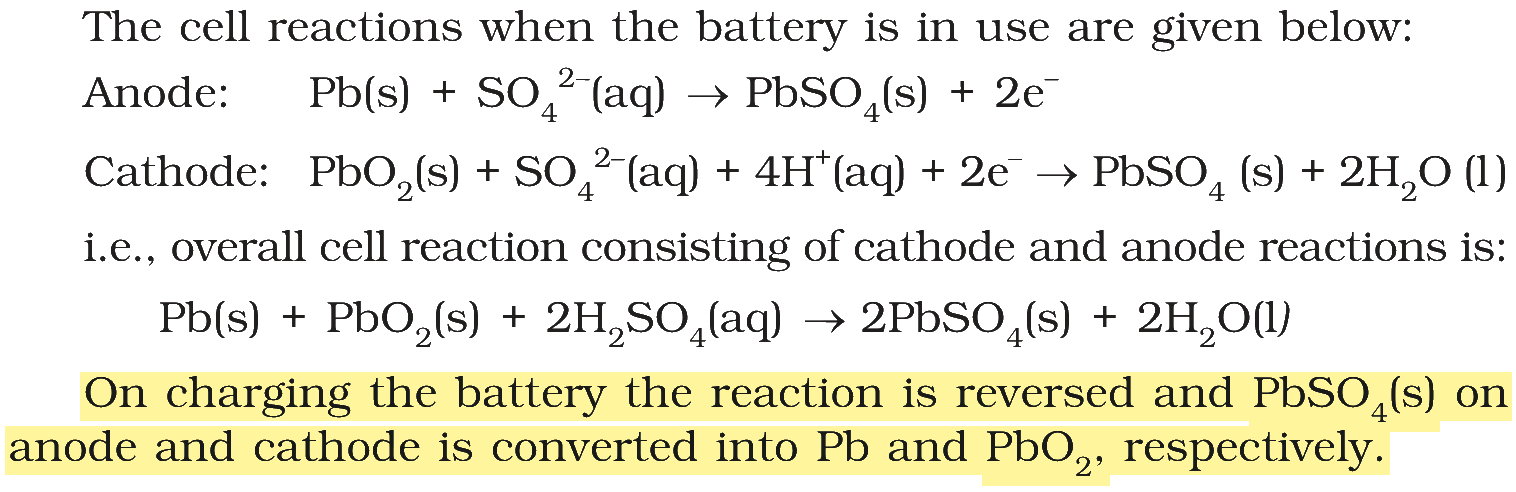
The lead storage battery is a secondary cell: the reactions that give current can be reversed by passing current through it. Its anode is lead, its cathode a grid of lead packed with lead dioxide, and its electrolyte about 38% sulphuric acid. On discharge, lead is oxidised to \( \ce{PbSO4} \) at the anode and \( \ce{PbO2} \) is reduced to \( \ce{PbSO4} \) at the cathode.
On charging, these reactions are reversed and both plates are restored. The plates keep the names they have when the battery is in use, so the lead plate is still called the anode and the lead dioxide plate the cathode:
\( \displaystyle \text{At the anode (lead plate): } \ce{PbSO4(s) + 2e- -> Pb(s) + SO4^2-(aq)} \)
\( \displaystyle \text{At the cathode (lead dioxide plate): } \ce{PbSO4(s) + 2H2O(l) -> PbO2(s) + SO4^2-(aq) + 4H+(aq) + 2e-} \)
At the anode the oxidation state of lead falls from +2 in \( \ce{PbSO4} \) to 0 in Pb, which is a reduction. So, while charging, PbSO4 on the anode is reduced to Pb, and \( \ce{PbSO4} \) on the cathode is converted into \( \ce{PbO2} \).
Why the other options are incorrect
Option (2) \(PbSO_4\) on cathode is reduced to \(Pb\) — Incorrect. The \( \ce{PbSO4} \) on the cathode (lead dioxide plate) is turned back into PbO2, not into lead.
Option (3) \(PbSO_4\) on anode is oxidized to \(PbO_2\) — Incorrect. \( \ce{PbO2} \) is formed on the other plate; on the anode \( \ce{PbSO4} \) becomes lead.
Option (4) \(PbSO_4\) on cathode is oxidized to \(Pb\) — Incorrect. Going from \( \ce{PbSO4} \) (+2) to Pb (0) is a gain of electrons, so it can only be a reduction, never an oxidation; and the cathode gives \( \ce{PbO2} \) (+4), which is the oxidation that does happen.
NCERT (2026-27 edition):
Secondary Batteries – …