
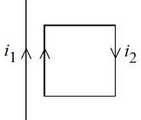
In the situation shown in the figure, the straight wire is fixed but the loop can move under magnetic force. The loop will:
Answer & explanation
Correct answer: option 2
The correct answer is Option (2) → moves towards the wire
Two parallel wires attract when their currents are in the same direction and repel when the currents are opposite. The force per unit length falls off with distance:
\( \displaystyle \frac{F}{l} = \frac{\mu_0 I_1 I_2}{2\pi d} \)
Readings from the figure: the side of the loop nearer the wire carries current upward, the same direction as \( i_1 \); the farther side carries current downward.
\( \text{near side: same direction} \Rightarrow \text{attraction, at the smaller distance} \)
\( \text{far side: opposite direction} \Rightarrow \text{repulsion, at the larger distance} \)
The near side is closer, so its attraction is larger than the repulsion on the far side. The forces on the top and bottom sides are equal and opposite and cancel. The net force pulls the loop towards the wire.
Why the other options are incorrect
Option (1) remains stationary — Incorrect. The two vertical sides are at different distances, so their forces are unequal.
Option (3) moves away from the wire — Incorrect. The repulsion acts on the far side, which is the weaker force.
Option (4) rotates about the wire — Incorrect. The forces lie in the plane of the loop and add up to a pull towards the wire.
NCERT (2026-27):
Force Between Two Parallel Currents, the Ampere – “… We have seen from above that currents flowing in the same direction attract each other. One can show that oppositely directed currents repel each other. … Let fba represent the magnitude of the force Fba per unit length. Then, from Eq. (4.17),
\( \displaystyle f_{ba} = \frac{\mu_0 I_a I_b}{2\pi d} \qquad (4.19) \)”