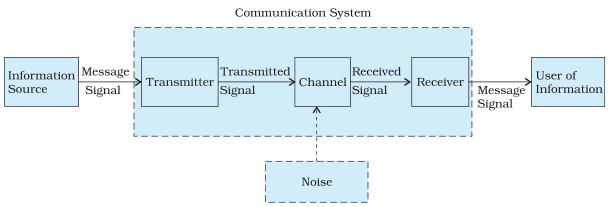
Arrange the following elements of a generalised communication system in the sequencial order:
(A) Channel
(B) Information source
(C) Transmitter
(D) Receiver
(E) User of information
Choose the correct answer from the options given below :
Answer & explanation
Correct answer: option 4
The correct answer is Option (4) → (B), (C), (A), (D), (E)
A communication system carries a message from the place where it is produced to the place where it is used, so the elements are arranged in the order in which the signal passes through them.
(B) Information source — produces the message signal, so it comes first.
(C) Transmitter — converts the message signal into a form suitable for sending through the medium.
(A) Channel — the physical medium (wires, cable or free space) that carries the transmitted signal; noise gets added to the signal here.
(D) Receiver — picks up the received signal and reconstructs a recognisable form of the message.
(E) User of information — the final destination of the message.
Hence the order is (B) → (C) → (A) → (D) → (E).
Note: A similar question was also asked in CUET (UG) 2023 on 05-06-2023 (Slot 2), on 26-05-2023 (Slot 1) and on 24-05-2023 (Slot 3), and in CUET (UG) 2022 on 18-08-2022 (Slot 2).
Note: This question is from the pre-rationalised NCERT book (2022-23). The topic was removed from the latest NCERT book (2026-27), and it also appears to be out of the CUET 2026 syllabus.
NCERT (Pre-rationalised edition, 2022-23):
Elements of a Communication System – “… In a communication system, the transmitter is located at one place, the receiver is located at some other place (far or near) separate from the transmitter and the channel is the physical medium that connects them. … The purpose of the transmitter is to convert the message signal produced by the source of information into a form suitable for transmission through the channel. … The receiver has the task of operating on the received signal. It reconstructs a recognisable form of the original message signal for delivering it to the user of information.”