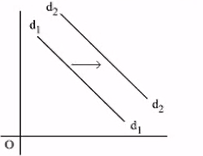
The figure shows a parallel shift of the demand curve to the right, from \( d_1d_1 \) to \( d_2d_2 \). Which of the following is not a reason for this shift?
Answer & explanation
Correct answer: option 4
The correct answer is Option (4) → Price
In the figure, the demand curve d1d1 moves to the right to d2d2. So more is demanded at every price. A shift of this kind comes from a change in something other than the good’s own price. It may be the consumer’s income, the prices of related goods, or tastes and preferences.
Option (1) Taste — Reason for the shift (Incorrect). When the taste for a good grows, people want more of it at every price, so the curve shifts to the right.
Option (2) Fashion — Reason for the shift (Incorrect). A good that comes into fashion becomes more popular. Tastes move towards it and the curve shifts to the right.
Option (3) Preferences — Reason for the shift (Incorrect). A change in preferences in favour of the good raises its demand at every price.
Option (4) Price — Not a reason for the shift (Correct). A change in the good’s own price makes the buyer move along the same demand curve. The curve itself stays where it is.
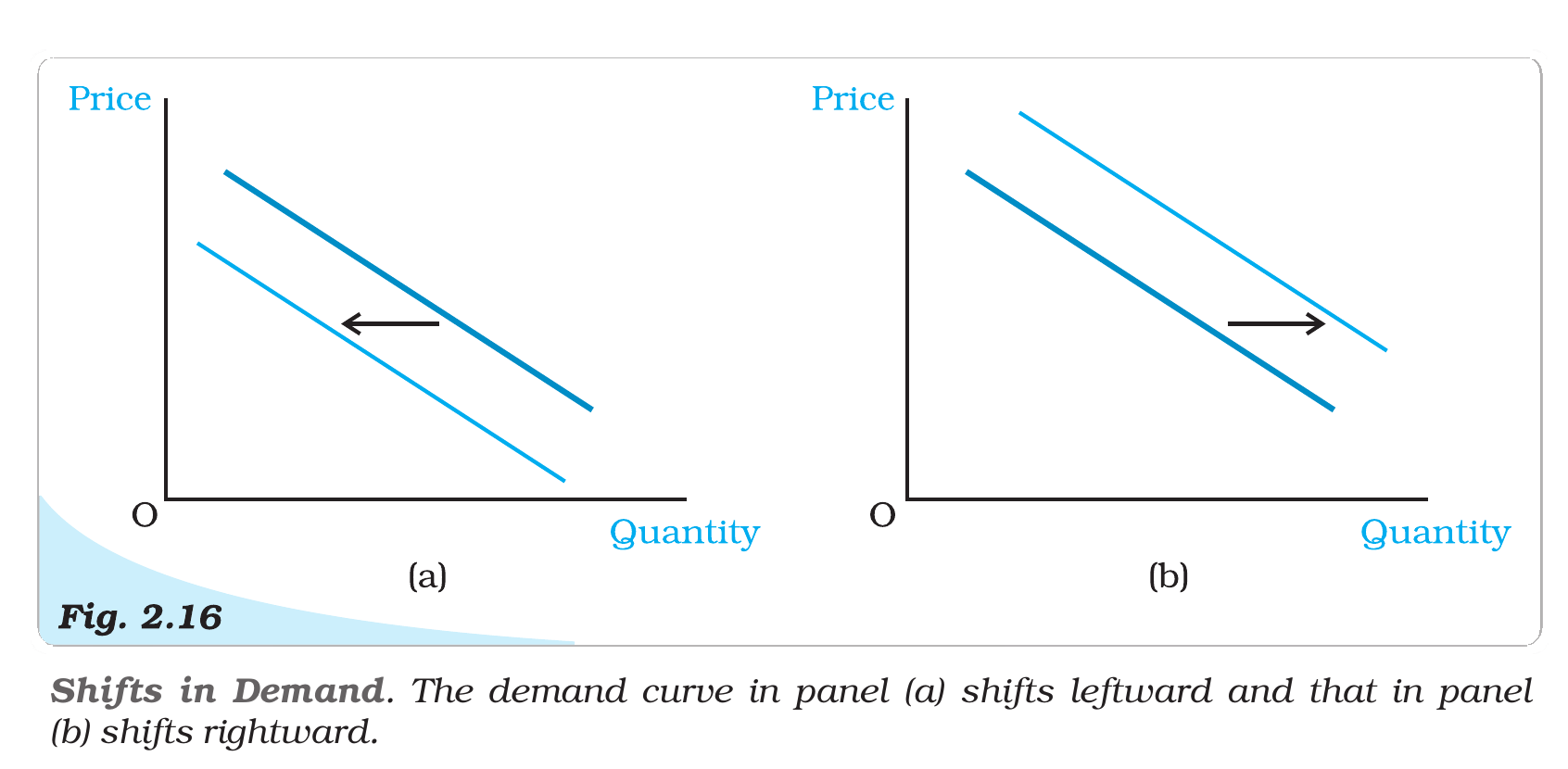
NCERT (2026-27): “2.4.5 Shifts in the Demand Curve … The demand curve can also shift due to a change in the tastes and preferences of the consumer. If the consumer’s preferences change in favour of a good, the demand curve for such a good shifts rightward. On the other hand, the demand curve shifts leftward due to an unfavourable change in the preferences of the consumer. The demand curve for ice-creams, for example, is likely to shift rightward in the summer because of preference for ice-creams goes up in summer. Revelation of the fact that cold-drinks might be injurious to health can adversely affect preferences for cold-drinks. This is likely to result in a leftward shift in the demand curve for cold-drinks. Shifts in the demand curve are depicted in Figure 2.16. It may be mentioned that shift in demand curve takes place when there is a change in some factor, other than the price of the commodity. 2.4.6 Movements along the Demand Curve and Shifts in the Demand Curve … Thus, any change in the price leads to movements along the demand curve. On the other hand, changes in any of the other things lead to a shift in the demand curve.…”
|