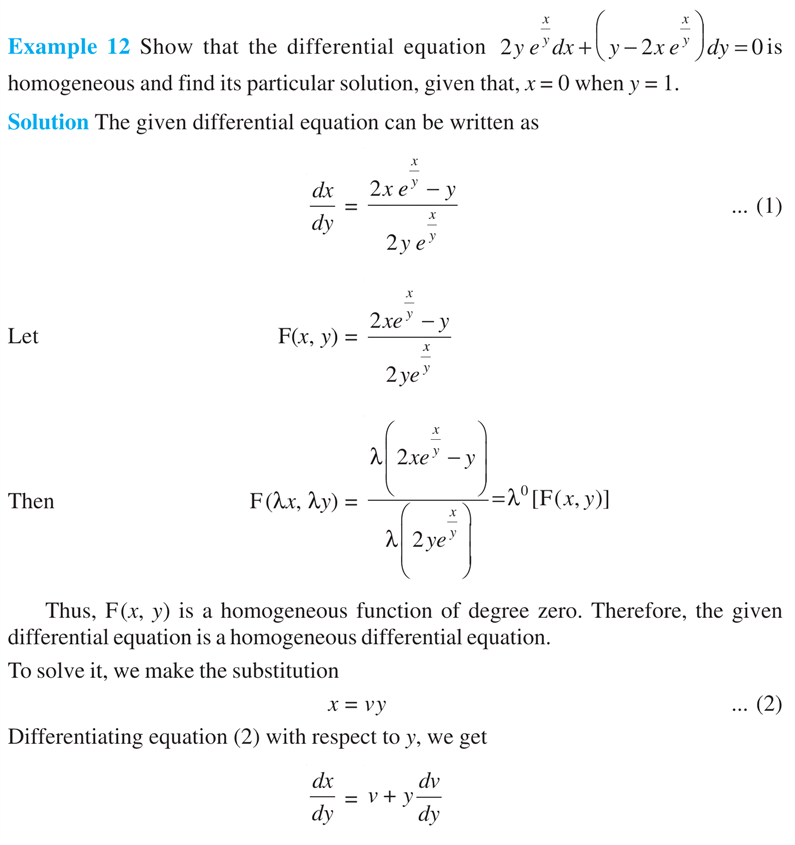
For \(y \ne 0\), the particular solution of the differential equation \(2ye^{x/y} dx + (y - 2xe^{x/y})dy = 0\) at the point (1, 1) is
Answer & explanation
Correct answer: option 1
The correct answer is Option (1) → \(\ln |y|+ 2(e^{x/y}-e) = 0\)
Written as dx/dy, the equation is homogeneous (a function of x/y):
\(\displaystyle \frac{dx}{dy} = \frac{2xe^{x/y} - y}{2ye^{x/y}}\)
Let x = vy, so that
\(\displaystyle \frac{dx}{dy} = v + y\frac{dv}{dy}\)
Then
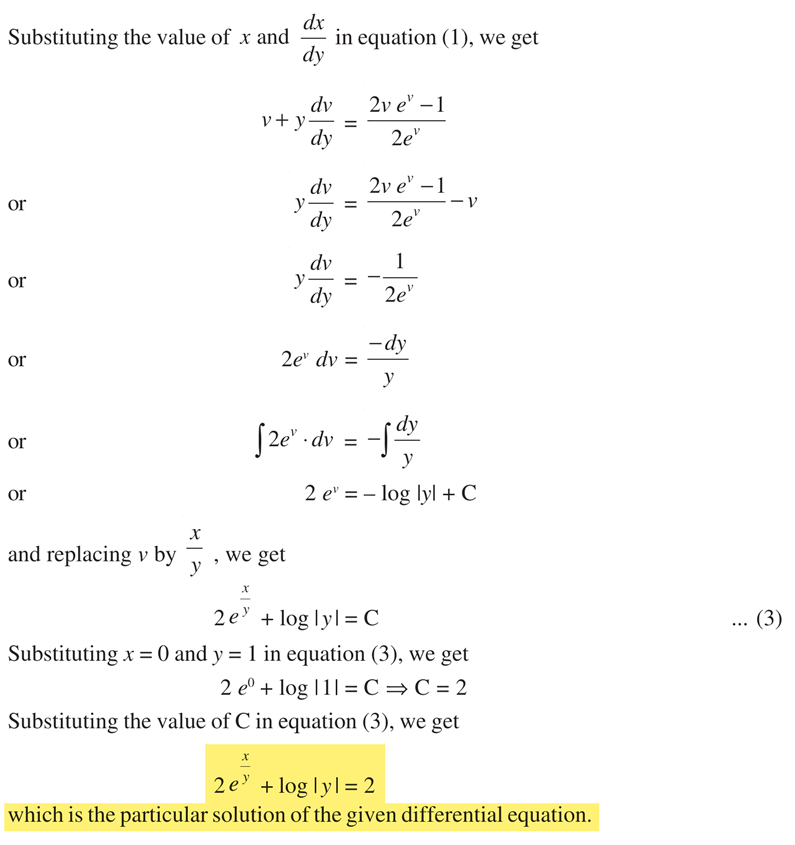
\(\displaystyle v + y\frac{dv}{dy} = \frac{2ve^{v} - 1}{2e^{v}}\)
\(\displaystyle y\frac{dv}{dy} = -\frac{1}{2e^{v}}\)
Separating the variables:
\(\displaystyle 2e^{v}\,dv = -\frac{dy}{y}\)
\(2e^{v} = -\ln|y| + C\)
\(\ln|y| + 2e^{x/y} = C\)
At (1, 1): \(0 + 2e = C\), so C = 2e and
\(\ln|y| + 2(e^{x/y} - e) = 0\)
NCERT (2026-27 edition):
Homogeneous Differential Equations