Under a flexible exchange rate system, Indian residents travel to the US, Indian residents buy more goods imported from the US, and US investors take their money out of Indian equity and bond markets. What will happen to the value of the rupee in terms of the dollar?
Answer & explanation
Correct answer: option 2
The correct answer is Option (2) → The rupee will depreciate
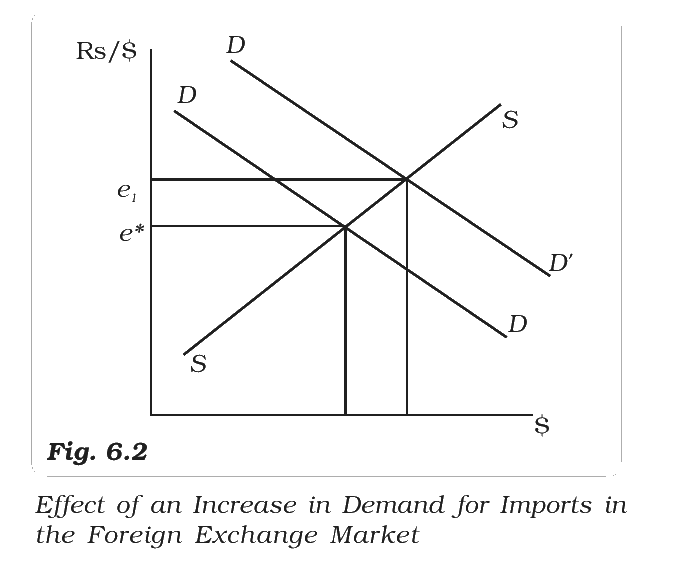
All three events raise the demand for dollars. Travel and imports must be paid in dollars, and US investors leaving Indian markets change their rupees into dollars.
Under a flexible rate, the demand curve for dollars shifts right. More rupees are needed for one dollar, so the rupee depreciates.
Devaluation and revaluation are government actions under a fixed rate, so they do not apply here.
NCERT (2026-27): “Demand for Foreign Exchange People demand foreign exchange because: they want to purchase goods and services from other countries; they want to send gifts abroad; and, they want to purchase financial assets of a certain country. …” “Flexible Exchange Rate … Suppose the demand for foreign goods and services increases (for example, due to increased international travelling by Indians), then as depicted in Fig. 6.2, the demand curve shifts upward and right to the original demand curve. …” “… Increase in exchange rate implies that the price of foreign currency (dollar) in terms of domestic currency (rupees) has increased. This is called Depreciation of domestic currency (rupees) in terms of foreign currency (dollars).”
|