Inside the Graafian follicle, the secondary oocyte forms a new membrane surrounding it. What is this membrane called?
Answer & explanation
Correct answer: option 2
The correct answer is Option (2) → Zona pellucida
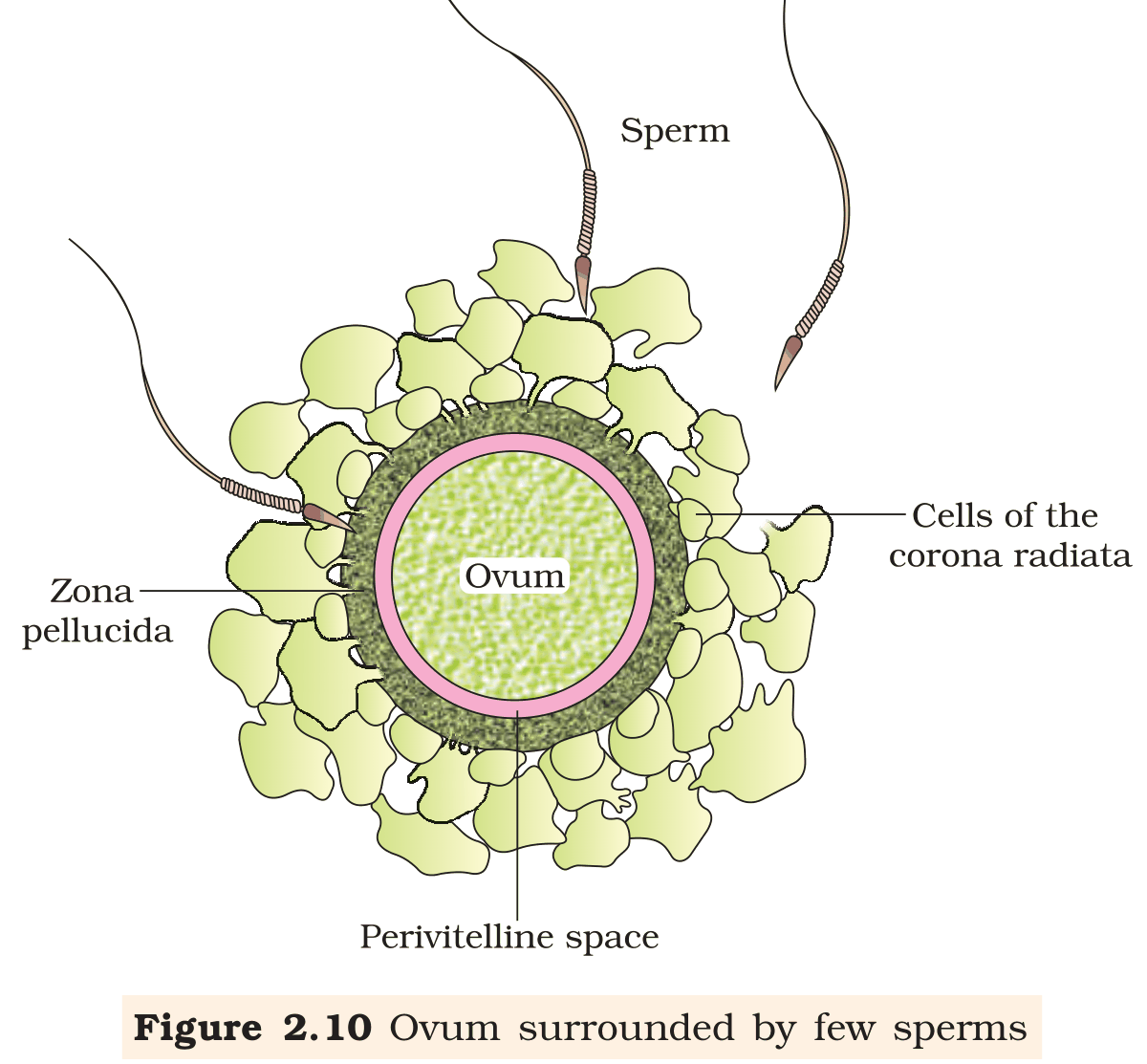
In the ovary, a primary follicle grows into secondary and tertiary follicles and then into the mature Graafian follicle. Inside the Graafian follicle the secondary oocyte forms a new membrane around itself, the zona pellucida, and the follicle then ruptures to release it.
Option (1) Theca interna — Incorrect. The theca interna is the inner part of the theca layer of the tertiary follicle. It belongs to the follicle wall, not to the oocyte.
Option (2) Zona pellucida — Correct. The zona pellucida is the membrane formed by the secondary oocyte itself. It stays around the ovum after ovulation, and at fertilisation the sperm comes in contact with this layer.
Option (3) Theca externa — Incorrect. The theca externa is the outer part of the theca layer. Like the theca interna, it is part of the follicle around the oocyte.
Option (4) Corona radiata — Incorrect. The corona radiata is made of cells that surround the zona pellucida on the outside, as shown in Figure 2.10. It is a layer of cells, not a membrane formed by the oocyte.
NCERT Extract:
Gametogenesis – “… The primary follicles get surrounded by more layers of granulosa cells and a new theca and are called secondary follicles. The secondary follicle soon transforms into a tertiary follicle which is characterised by a fluid filled cavity called antrum. The theca layer is organised into an inner theca interna and an outer theca externa.”
Gametogenesis – “… The tertiary follicle further changes into the mature follicle or Graafian follicle (Figure 2.7). The secondary oocyte forms a new membrane called zona pellucida surrounding it. The Graafian follicle now ruptures to release the secondary oocyte (ovum) from the ovary by the process called ovulation.”