
Match List - I with List - II.
| List - I | List - II |
| (Field lines) | (Charge configuration) |
(A) 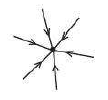 | (I) \( q \lt 0 \) |
(B) 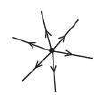 | (II) Electric dipole |
(C) 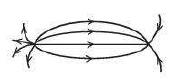 | (III) \( q \gt 0 \) |
(D) 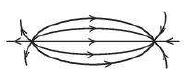 | (IV) Unequal charges |
Choose the correct answer from the options given below :
Answer & explanation
Correct answer: option 4
The correct answer is Option (4) → (A)-(I), (B)-(III), (C)-(IV), (D)-(II)
Electric field lines start on positive charges and end on negative charges, and the number of lines at a charge is proportional to the size of the charge.
(A) — this matches (I) \( q \lt 0 \). All the lines point towards the charge and end on it, which is the field of a negative point charge.
(B) — this matches (III) \( q \gt 0 \). All the lines point away from the charge, which is the field of a positive point charge.
(C) — this matches (IV) Unequal charges. More lines leave the left-hand charge than end on the right-hand one, so the two charges are not of equal size; the extra lines from the larger charge go off elsewhere.
(D) — this matches (II) Electric dipole. The pattern is symmetric: as many lines end on the right-hand charge as leave the left-hand charge, so the charges are equal and opposite.