Which of the following statements is Incorrect regarding f-block elements?
Answer & explanation
Correct answer: option 4
The correct answer is Option (4) → Tb (III) has a half-filled f-orbital and act as oxidant
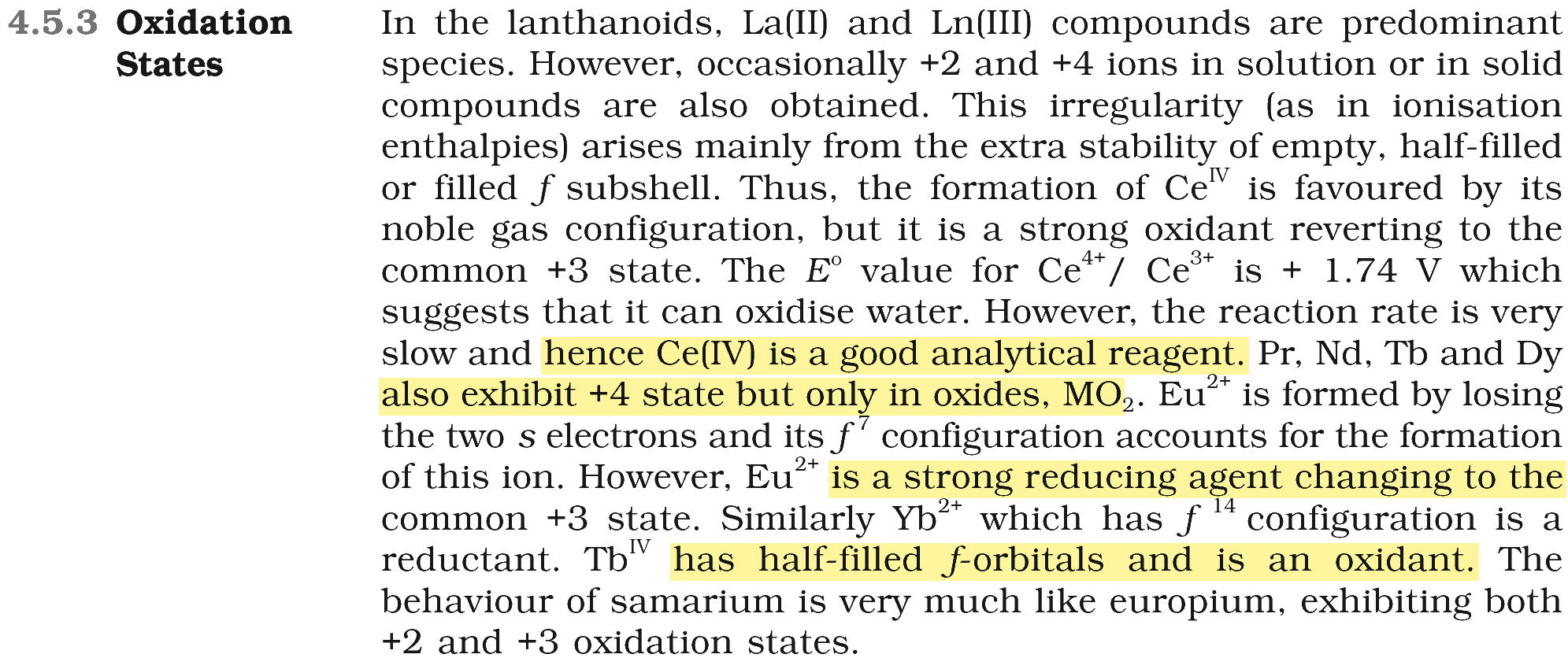
The common oxidation state of the lanthanoids is +3. A +2 or +4 ion forms when it has an empty, half-filled or completely filled f subshell, and it tends to return to +3: a +2 ion is a reducing agent and a +4 ion is an oxidising agent.
Terbium (Z = 65) is [Xe]4f96s2. Losing the two 6s electrons and one 4f electron gives Tb3+: 4f8, which is not half-filled, and it is already in the stable +3 state. Losing one more 4f electron gives Tb4+: 4f7; it is Tb(IV) that has the half-filled f subshell and acts as an oxidant.
Option (1) Ce (IV) is a good analytical reagent. — A correct statement about f-block elements. Cerium (Z = 58) is [Xe]4f15d16s2; losing all four outer electrons gives \( \ce{Ce^{4+}} \): 4f0. \( \ce{Ce^{4+}} \) is a strong oxidising agent (E° = +1.74 V), used in redox titrations.
Option (2) Nd exhibits a +4 oxidation state but only in oxide form. — A correct statement about f-block elements. Neodymium shows +4 only in its oxide, NdO2.
Option (3) Eu2+ is strong reducing agent. — A correct statement about f-block elements. Europium (Z = 63) is [Xe]4f76s2; losing the two 6s electrons gives \( \ce{Eu^{2+}} \): 4f7, which readily loses an electron to become \( \ce{Eu^{3+}} \).
Option (4) Tb (III) has a half-filled f-orbital and act as oxidant — The incorrect statement. Tb3+ is 4f8; it is Tb(IV), 4f7, that has the half-filled f subshell and acts as an oxidant.
NCERT (2026-27 edition):
Oxidation States