


CUET Preparation Today
Ethyl alcohol can be prepared from the following set of reactants and subsequent hydrolysis of adduct: |
\(HCHO + CH_3CH_2MgX\) \(CH_3CHO + CH_3CH_2MgX\) \(HCHO + CH_3MgX\) \(CH_3CHO + CH_3MgX\) |
\(HCHO + CH_3MgX\) |
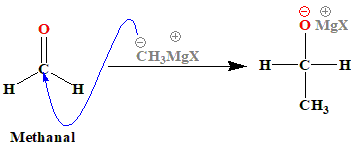
The correct answer is option 3. \(HCHO + CH_3MgX\). The Grignard reagent is a compound where a magnesium atom is bonded to an organic group and a halogen. In this case, \( CH_3MgX \) is the Grignard reagent, where \( CH_3 \) is the methyl group and \( X \) is a halogen (such as bromine or chlorine). Nucleophilic Addition to Formaldehyde: Formaldehyde (\( HCHO \)) has a carbonyl group (C=O). The carbonyl carbon is electrophilic and susceptible to nucleophilic attack. The Grignard reagent, being a strong nucleophile, attacks this carbonyl carbon. The reaction can be summarized as:
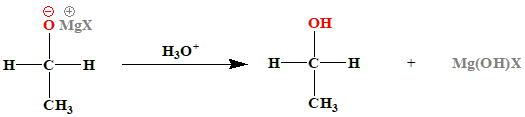
To convert the magnesium alkoxide to the final alcohol, the reaction mixture is treated with water or a dilute acid. This step hydrolyzes the intermediate, replacing the \( MgX \) group with a hydrogen atom:
Summary In summary, formaldehyde reacts with a methyl Grignard reagent to form an intermediate magnesium alkoxide. After acid workup, this intermediate is hydrolyzed to yield ethanol. This reaction is an example of a nucleophilic addition reaction of a Grignard reagent to an aldehyde. |