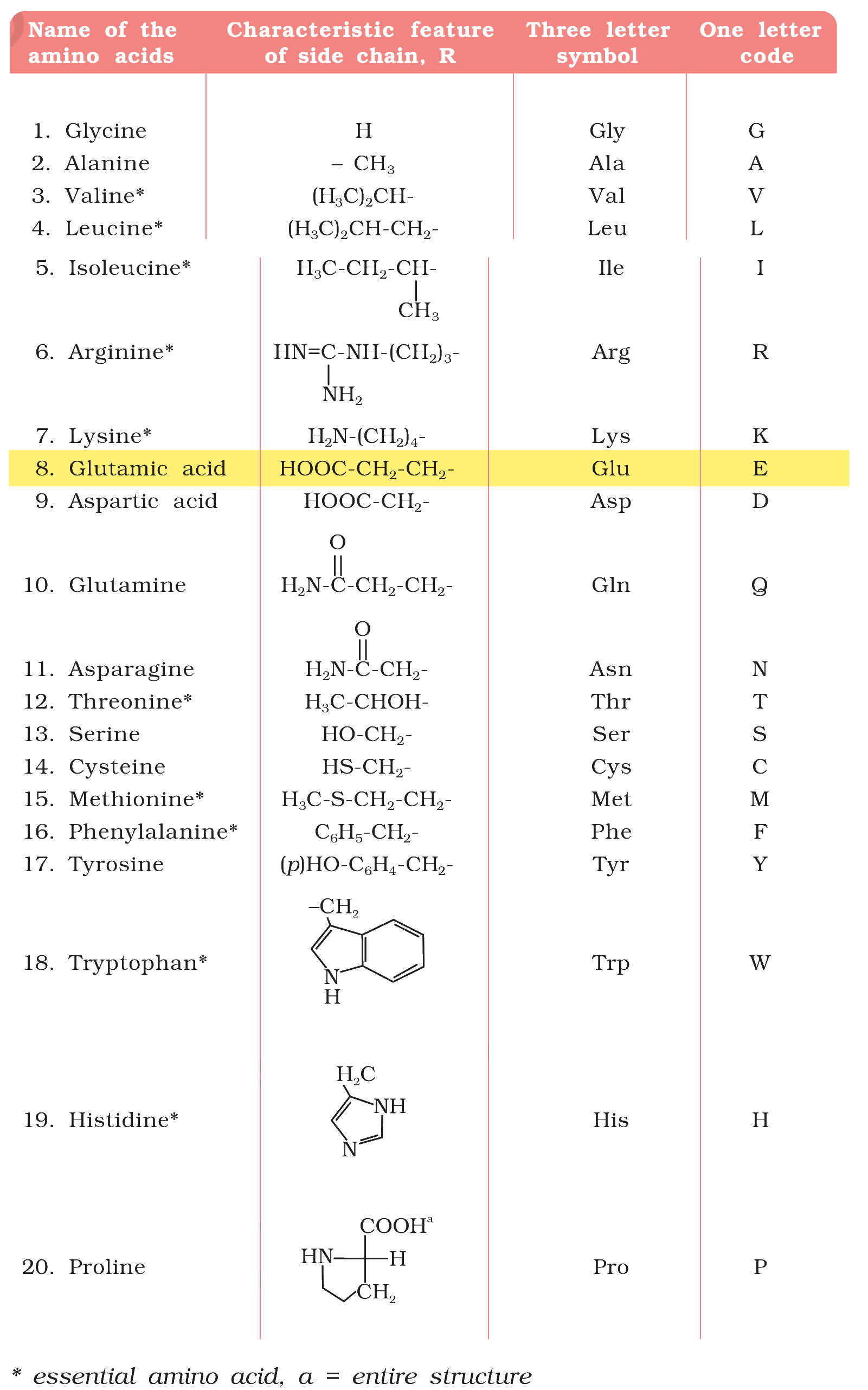
Amino acids contain amino (–NH2) and carboxyl (–COOH) functional groups. Depending upon the relative position of amino group with respect to carboxyl group, the amino acids can be classified as α, β, γ, δ and so on. Only α-amino acids are obtained on hydrolysis of proteins. All α-amino acids have trivial names, which usually reflect the property of that compound or its source. Amino acids are classified as acidic, basic or neutral depending upon the relative number of amino and carboxyl groups in their molecule. Equal number of amino and carboxyl groups makes it neutral; more number of amino than carboxyl groups makes it basic and more carboxyl groups as compared to amino groups makes it acidic. The amino acids, which can be synthesized in the body, are known as nonessential amino acids. On the other hand, those which cannot be synthesized in the body and must be obtained through diet, are known as essential amino acids.
Identify the amino acid with the formula HOOC-CH2-CH2-CH(NH2)-COOH.
Answer & explanation
Correct answer: option 1
The correct answer is Option (1) → Glutamic acid
An α-amino acid has the general formula \( \ce{R-CH(NH2)-COOH} \); the amino acids differ only in the side chain R. Writing the given formula in this way:
\( \displaystyle \underbrace{\ce{HOOC-CH2-CH2}}_{\text{R}}\ce{-CH(NH2)-COOH} \)
So R = \( \ce{HOOC-CH2-CH2-} \): two \( \ce{CH2} \) groups ending in a carboxyl group. This is the side chain of glutamic acid. With two –COOH groups and one –NH2 group, it is an acidic amino acid.
Why the other options are incorrect
Option (2) Aspartic acid — Incorrect. Its side chain is \( \ce{HOOC-CH2-} \), with only one \( \ce{CH2} \) group.
Option (3) Glutamine — Incorrect. Its side chain is \( \ce{H2N-CO-CH2-CH2-} \): the same chain length, but it ends in an amide group, not a carboxyl group.
Option (4) Asparagine — Incorrect. Its side chain is \( \ce{H2N-CO-CH2-} \): an amide group and only one \( \ce{CH2} \) group.
NCERT (2026-27 edition):
Table 10.2: Natural Amino Acids