
CUETMOCK
  • Pricing
  • Mentors
Log inStart freeStart free mocks→

First test, then trust

Try a free CUET mock test.

Join 5,00,000+ students who rehearsed exam day on the exact NTA screen before sitting CUET. On the web and on Android.

Start free mocks →Get the Android app
CUETMOCK

India's #1 CUET Mock Test Platform. Original NCERT-based questions on the exact NTA exam screen — trusted by 5,00,000+ students since CUET 2022.

Get it onGoogle PlayScan to download the CUETMOCK app

Mock tests

  • CUET mock test series
  • Commerce mocks
  • Humanities (Arts) mocks
  • Science mocks
  • Languages & GAT mocks
  • Free practice questions
  • Pricing

Resources

  • CUET exam guide
  • CUET syllabus
  • Universities accepting CUET
  • Expert blogs
  • News & notifications
  • Webinars & counselling
  • CUET score calculator
  • How we estimate your rank
  • FAQs

Company

  • About us
  • Our leadership & team
  • Our toppers
  • Mentors
  • For schools
  • Contact us
  • Terms
  • Privacy
  • Refund policy

Talk to us

+91 7696 6630 56info@cuetmock.comWhatsApp us

Our other platforms

  • JEE Mock — For IIT-JEE aspirants
  • NEET Mock — For NEET aspirants

Newsletter

Exam updates, study material and offers — no spam.

© 2026 NYC Ventures Pvt. Ltd.

701-702, Royal Business Park, Zirakpur, Punjab - 140603

  • Terms of use
  • Privacy policy
  • Refund policy
  • Contact us

iCUETMOCK is an independent preparation platform, not affiliated with the National Testing Agency (NTA). Always check exam details on the official NTA website.

  • Home
  • Mock tests
  • CUET guide
  • Pricing
  • Log in
Home/Practice questions/Biology
BiologyHuman Health and Disease

How many peptide chains are present in each antibody molecule?

In the context of the given picture, answer the following questions:
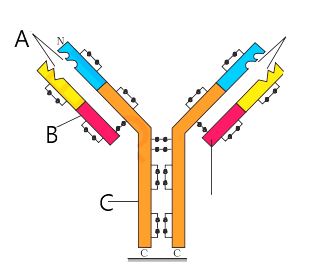
How many peptide chains are present in each antibody molecule?

Answer & explanation+

Correct answer: option 4

The correct answer is Option (4) → 4

An antibody is a Y-shaped protein made of four peptide (polypeptide) chains. The chains are held together by disulphide (S–S) bonds. So an antibody is written as H2L2, which means two heavy and two light chains, four in all.

NCERT Extract:
Acquired Immunity – “… The B-lymphocytes produce an army of proteins in response to pathogens into our blood to fight with them. These proteins are called antibodies. The T-cells themselves do not secrete antibodies but help B cells to produce them. Each antibody molecule has four peptide chains, two small called light chains and two longer called heavy chains. Hence, an antibody is represented as H2L2.”

Advertisement

Practise more on Human Health and Disease

Chapter-wise mocks on the real NTA exam screen, with solutions and your rank. Your first mocks are free.

Start free mocks →

Advertisement

Next questions

  1. Assertion: At the time of admission of a partner, the value of goodwill of the firm is determined. Reasoning: Goodwill of the firm is value…Accountancy Part A · Admission of a Partner
  2. A line left out at the very start of the passage names who coined the term Dalit. According to that line, who coined it?Sociology · Indian Society: Patterns of Social Inequality and Exclusion
  3. Statement I: Zr and Hf exhibit similarity in properties Statement II: Zr and Hf lie in same group of the periodicChemistry · Inorganic: D and F Block Elements
  4. Match List-I with List-IIList-IList-II(Pattern Series)(Missing Term)(A)43, 64, 96, 139, 193, ?(I)200(B)137, 148, 161, 176, 193, ?(II)291(C)…General Aptitude Test · Verbal Reasoning
  5. What is % of the change in total revenue?Accountancy Part B · Analysis of Financial Statements
  6. Which of the following is NOT correct?Sociology · Indian Society: Challenges of Cultural Diversity
  7. Physics · Electromagnetic Induction
  8. Match List - I with List - II.List-IList-IIPhysical QuantitiesExpression(A) Electrostatic Force(I) 1/(4πε_0)q/r (B) Electrostatic Potential…Physics · Electrostatic Potential and Capacitance
  9. Physics · Wave Optics
  10. Revenue receipts do not lead to which of the following?Economics · Macro Economics: Government Budget and Economy