
Solve the following problem graphically:
Maximize $Z = 5x + 2y$ subject to the constraints $3x + 5y ≤ 15, 5x + 2y ≤ 10, x, y ≥ 0$.
Answer & explanation
Correct answer: option 1
The correct answer is Option (1) → Maximum $Z = 10$ at $(2, 0)$ and $\left(\frac{20}{19}, \frac{45}{19} \right)$
We draw the lines $3x + 5y = 15$ and $5x + 2y 10$, and shade the region satisfied by the given inequalities. The shaded region in the adjoining figure shows the feasible region determined by the given constraints. We observe that region OABC is a convex polygon and bounded, and has corner points $O(0, 0), A(2, 0), B\left(\frac{20}{19}, \frac{45}{19} \right)$ and $C(0,3)$.
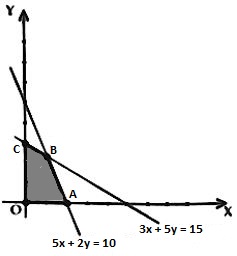
Using corner point method, we see that at (0, 0), Z = 0; at A(2, 0), Z = 10; at $B \left(\frac{20}{19},\frac{45}{19}\right)$, Z = 10; at C(0, 3), Z = 6.
Thus, Z is maximum at both A and B - in fact all points on segment AB produce this maximum value of Z. Thus, we have multiple optimal solutions.
Here the optimal value (10) is unique, but there are an infinite number of optimal solutions.