
The intensity of light due to (see figure) interference of two waves (1) and (2) which have path difference of \( \lambda \) is: (where \( I_0 \) = Intensity of each wave)
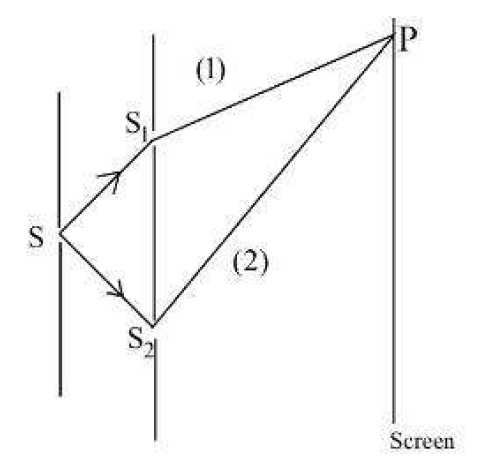
Answer & explanation
Correct answer: option 4
The correct answer is Option (4) → \( 4I_0 \)
When two coherent waves superpose, the resultant intensity depends on their phase difference \( \phi \).
\( \displaystyle I = I_1 + I_2 + 2\sqrt{I_1 I_2}\,\cos\phi \)
A path difference of \( \lambda \) gives a phase difference of \( 2\pi \), so the waves meet in phase.
\( \displaystyle \phi = \frac{2\pi}{\lambda} \times \lambda = 2\pi, \qquad \cos 2\pi = 1 \)
With \( I_1 = I_2 = I_0 \):
\( \displaystyle I = I_0 + I_0 + 2\sqrt{I_0 \cdot I_0} = 4I_0 \)
This is constructive interference: the amplitude doubles, so the intensity becomes four times that of one wave.
Note: This question is from NCERT (2026-27). NTA sets numerical questions from NCERT too, so do not ignore NCERT while practising numericals.
NCERT (2026-27):
Coherent and Incoherent Addition of Waves – “… To summarise: If we have two coherent sources S1 and S2 vibrating in phase, then for an arbitrary point P whenever the path difference,
\( \displaystyle S_1P \sim S_2P = n\lambda \qquad (n = 0, 1, 2, 3, \ldots) \qquad (10.9) \)
we will have constructive interference and the resultant intensity will be 4I0; the sign ~ between S1P and S2 P represents the difference between S1P and S2 P. On the other hand, if the point P is such that the path difference,
\( \displaystyle S_1P \sim S_2P = \left(n + \frac{1}{2}\right)\lambda \qquad (n = 0, 1, 2, 3, \ldots) \qquad (10.10) \)
we will have destructive interference and the resultant intensity will be zero.”