Read the passage carefully and answer the questions based on the passage:
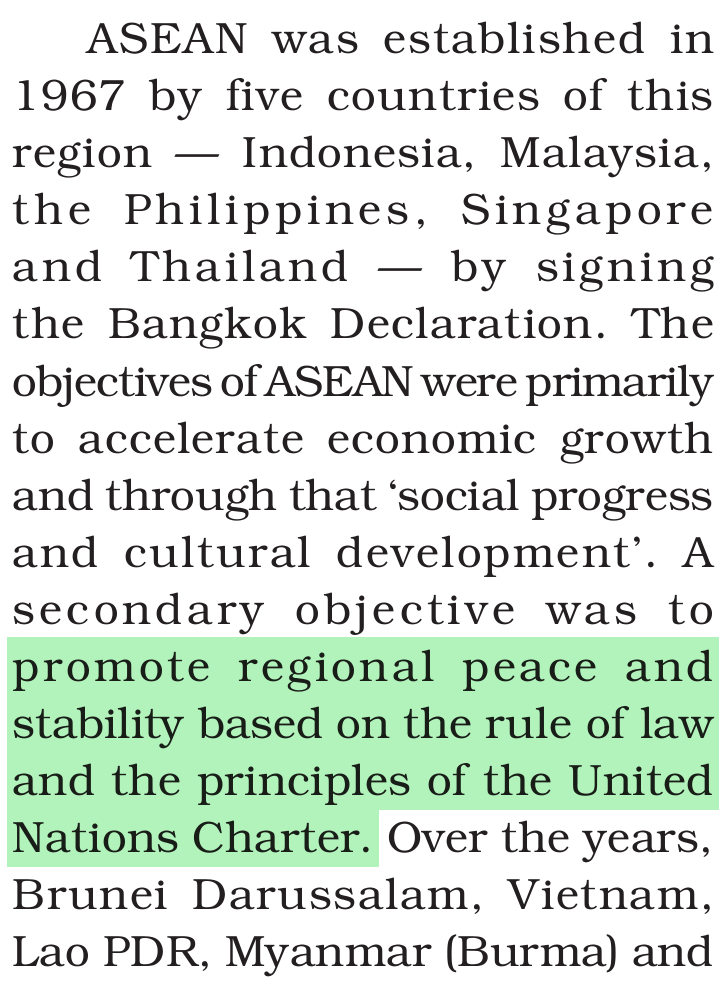
ASEAN was established in 1967 by five countries when they signed the Bangkok Declaration. The objectives of ASEAN were primarily to accelerate economic growth as well as promoting social progress and cultural development. Another objective was to promote regional peace and stability based on the rule of law and the principles of the United Nations Charter. Over the years, Brunei Darussalam, Vietnam, Lao PDR, Myanmar and Cambodia joined ASEAN taking its strength to ten.
Unlike the EU, there is little desire in ASEAN for supranational structures and institutions. ASEAN countries have celebrated what has become known as the 'ASEAN Way', a form of interaction that is informal, non-confrontationist and cooperative. The respect for national sovereignty is critical to the functioning of ASEAN.
With some of the fastest growing economies in the world as its members, ASEAN broadened its objectives beyond the economic and social spheres. In 2003, ASEAN moved along the path of the EU by agreeing to establish an ASEAN Community, comprising three pillars, namely, the ASEAN Security Community, the ASEAN Economic Community and the ASEAN Socio-Cultural Community.
Which one of the following principles of ASEAN is related to the liberal global powers?
Answer & explanation
Correct answer: option 2
The correct answer is Option (2) → Rule of law
The passage says that one objective of ASEAN was to promote regional peace and stability based on the rule of law and the principles of the United Nations Charter. The rule of law is a core liberal principle in international relations: states, like citizens, are bound by agreed rules. So, of the four options, it is the principle that aligns ASEAN with the liberal global powers.
NCERT (2026-27): Contemporary World Politics — Chapter 2: Contemporary Centres of Power
|