Select the correct option(s) from the following statements:
A. A catalyst lowers the activation energy of a chemical reaction.
B. A catalyst does not alter the Gibbs energy (ΔG) of a chemical reaction.
C. A catalyst can catalyze a non-spontaneous reaction.
D. A catalyst changes the equilibrium constant (K), by helping the attainment of equilibrium faster.
Answer & explanation
Correct answer: option 4
The correct answer is Option (4) → A and B only
A catalyst provides an alternative pathway for a reaction, with a lower activation energy. More molecules then have enough energy to react, so by the Arrhenius equation the rate constant increases:
\( \displaystyle k=A\,e^{-E_a/RT} \)
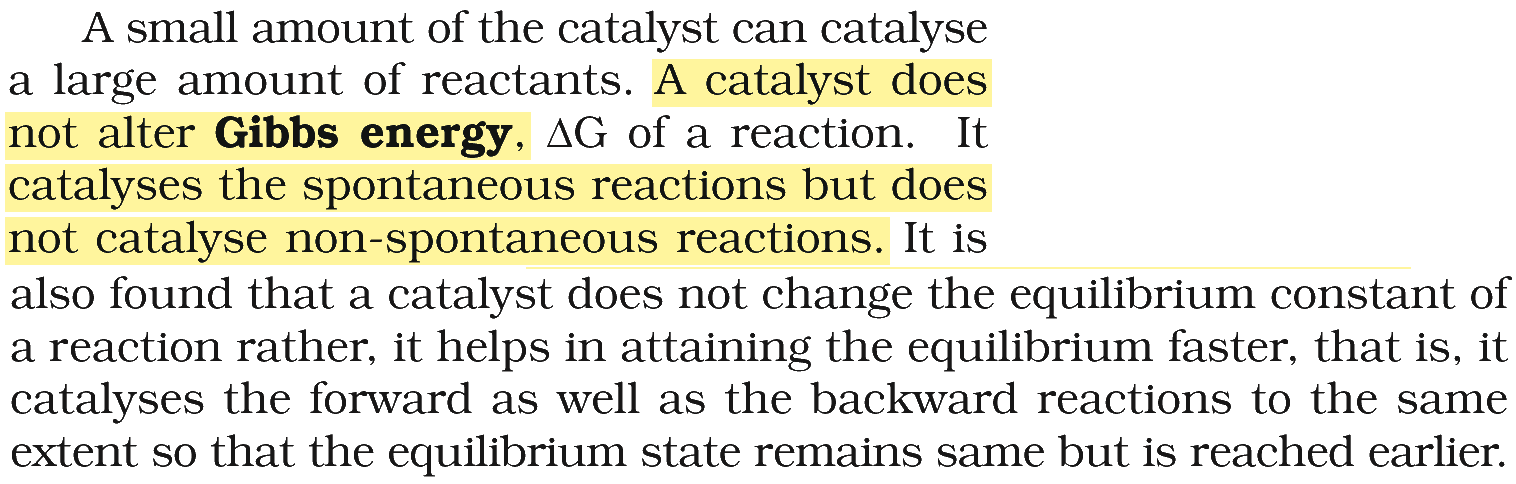
(A) A catalyst lowers the activation energy of a chemical reaction. — Correct. This is how a catalyst works: the new pathway has a lower energy barrier, so the reaction becomes faster.
(B) A catalyst does not alter the Gibbs energy (ΔG) of a chemical reaction. — Correct. ΔG depends only on the initial and final states, and a catalyst changes only the path between them.
(C) A catalyst can catalyze a non-spontaneous reaction. — Incorrect. A catalyst can speed up only a reaction that is already spontaneous (ΔG negative). It cannot make ΔG negative, so it cannot make a non-spontaneous reaction take place.
(D) A catalyst changes the equilibrium constant (K), by helping the attainment of equilibrium faster. — Incorrect. A catalyst speeds up the forward and backward reactions to the same extent. Equilibrium is reached sooner, but the equilibrium constant stays the same.
NCERT (2026-27 edition):
Effect of Catalyst – …