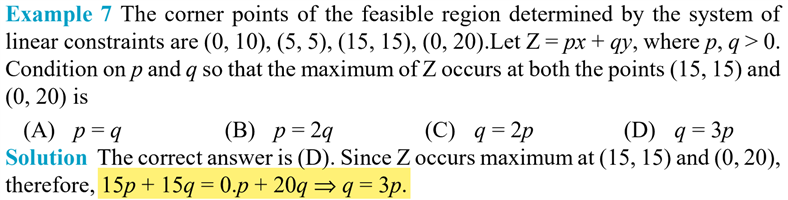
The corner points of a bounded feasible region determined by the following system of linear inequalities \(x + 3y \le 60, x + y \ge 10, x \le y, x \ge 0, y \ge 0\) are (0, 10), (5, 5), (15, 15) and (0, 20). Let \(z = 2px + qy, p, q \gt 0\). If maximum of z occurs at both (15, 15) and (0, 20), then the relation between \(p\) and \(q\) is
Answer & explanation
Correct answer: option 3
The correct answer is Option (3) → \(6p = q\)
If the maximum occurs at two corner points, z has the same value at both:
\(z(15, 15) = z(0, 20)\)
\(2p(15) + 15q = 20q\)
\(30p = 5q\)
\(6p = q\)
Check: with q = 6p, the values at the corners are
\(z(0, 10) = 60p,\quad z(5, 5) = 40p\)
\(z(15, 15) = 120p,\quad z(0, 20) = 120p\)
so 120p is indeed the maximum, reached at both points.
NCERT Exemplar:
Linear Programming