
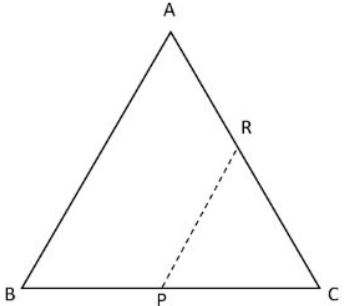
Three charges, each equal to +q, are placed at the corners of an equilateral triangle ABC of side 'a' as shown in the figure. P and R are the mid-points of BC and CA. The work done in taking a charge Q from point P to R is:
Answer & explanation
Correct answer: option 4
The correct answer is Option (4) → Zero
Work done in moving a charge $Q$ from point $P$ to $R$ in an electrostatic field is:
$W = Q \, \big(V_R - V_P\big)$
Potentials at $P$ and $R$ are due to the three charges $+q$ at vertices $A, B, C$ of an equilateral triangle of side $a$.
Coordinates approach:
- Let $A(0, \sqrt{3}a/2)$, $B(-a/2, 0)$, $C(a/2, 0)$.
- $P$ is midpoint of $BC$: $P(0, 0)$.
- $R$ is midpoint of $CA$: $R\big(\frac{a}{4}, \frac{\sqrt{3}a}{4}\big)$.
Potential at $P$:
Distances: $PB = PC = a/2$, $PA = \sqrt{3}a/2$.
$V_P = kq \Big(\frac{1}{a/2} + \frac{1}{a/2} + \frac{1}{\sqrt{3}a/2}\Big)$
$V_P = kq \Big(\frac{2}{a/2} + \frac{1}{(\sqrt{3}/2)a}\Big)$
$V_P = kq \Big(\frac{4}{a} + \frac{2}{\sqrt{3}a}\Big)$
Potential at $R$:
Distances: $RA = RC = a/2$, $RB = \sqrt{(3a/4)^2 + (\sqrt{3}a/4)^2} = \sqrt{12a^2/16} = \frac{\sqrt{3}a}{2}$.
$V_R = kq \Big(\frac{1}{a/2} + \frac{1}{a/2} + \frac{1}{\sqrt{3}a/2}\Big)$
$V_R = kq \Big(\frac{2}{a/2} + \frac{1}{(\sqrt{3}/2)a}\Big)$
$V_R = kq \Big(\frac{4}{a} + \frac{2}{\sqrt{3}a}\Big)$
Comparison:
$V_R = V_P$
Thus, $W = Q (V_R - V_P) = 0$
Answer: Work done = 0