
A ladder, $5 \text{ m}$ long, standing on a horizontal floor, leans against a vertical wall. If the top of the ladder slides downwards at the rate of $10 \text{ cm/s}$, then the rate at which the angle between the floor and the ladder is decreasing when lower end of ladder is $2 \text{ m}$ from the wall is
Answer & explanation
Correct answer: option 2
The correct answer is Option (2) → $\frac{1}{20} \text{ rad/s}$ ##
Let the angle between floor and the ladder be $\theta$.
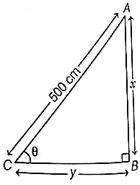
Let $AB = x \text{ cm}$ and $BC = y \text{ cm}$
$∴\sin \theta = \frac{x}{500} \text{ and } \cos \theta = \frac{y}{500} \quad \left[ ∵\sin \theta = \frac{P}{H} \text{ and } \cos \theta = \frac{B}{H} \right]$
$\Rightarrow x = 500 \sin \theta \text{ and } y = 500 \cos \theta$
Also, $\frac{dx}{dt} = 10 \text{ cm/s}$
$\Rightarrow 500 \cdot \cos \theta \cdot \frac{d\theta}{dt} = 10 \text{ cm/s}$
$\Rightarrow \frac{d\theta}{dt} = \frac{10}{500 \cos \theta} = \frac{1}{50 \cos \theta}$
For $y = 2 \text{ m} = 200 \text{ cm}$,
$\frac{d\theta}{dt} = \frac{1}{50 \cdot \frac{y}{500}} = \frac{10}{y}$
$= \frac{10}{200} = \frac{1}{20} \text{ rad/s}$