Read the passage and answer the following questions.
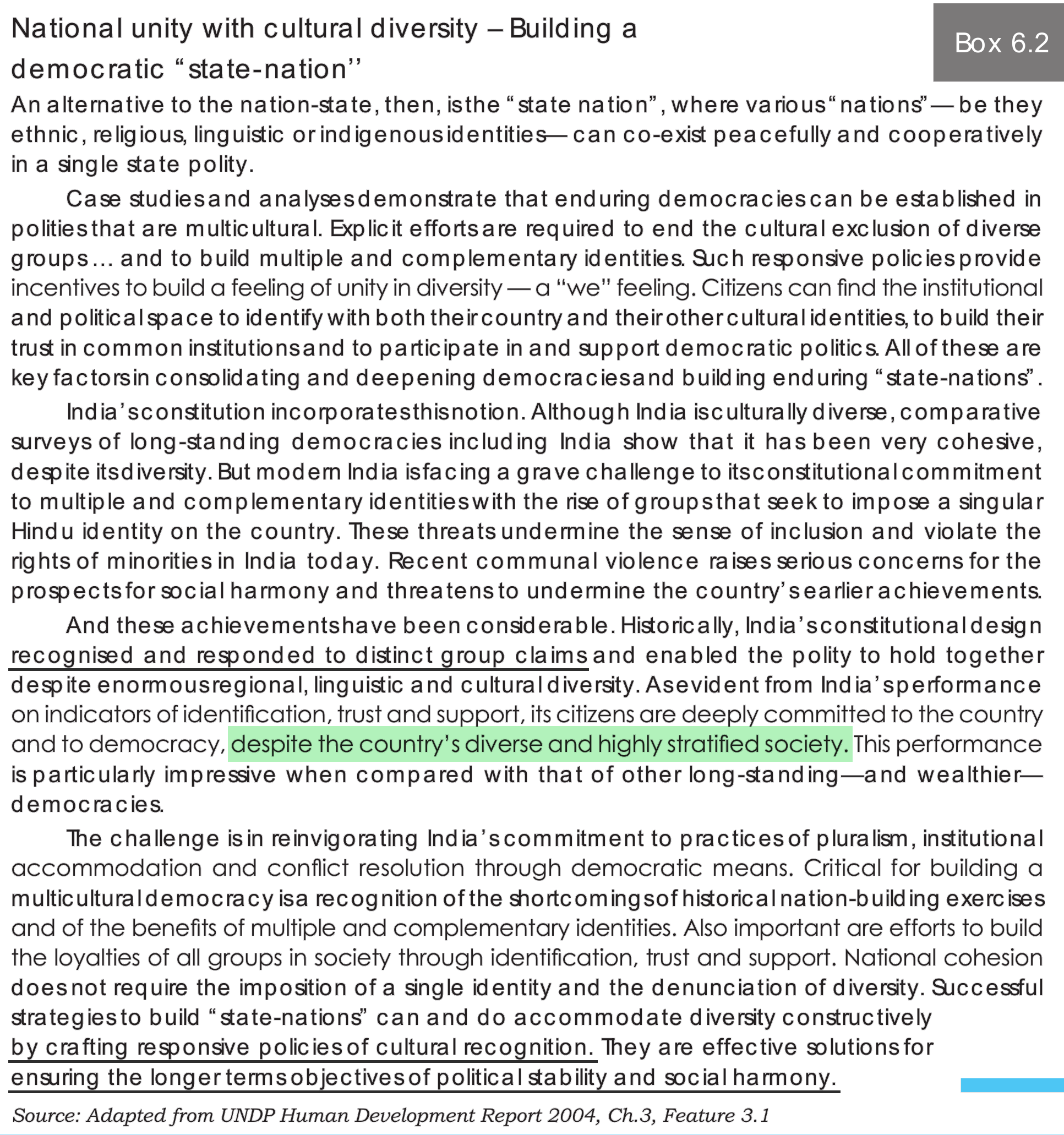
An alternative to the nation-state, then, is the "state nation", where various "nations" - be they ethnic, religious, linguistic or indigenous identities - can co-exist peacefully and cooperatively in a single state polity.
Case studies and analyses demonstrate that enduring democracies can be established in polities that are multicultural. Explicit efforts are required to end the cultural exclusion of diverse groups... and to build multiple and complementary identities. Such responsive policies provide incentives to build a feeling of unity in diversity- a "we" feeling. Citizens can find the institutional and political space to identify with both their country and their other cultural identities, to build their trust in common institutions and to participate in and support democratic politics. All of these are key factors in consolidating and deepening democracies and building enduring "state nations".
India's constitution incorporates this notion. Although India is culturally diverse, comparative surveys of long-standing democracies including India show that it has been very cohesive, despite its diversity.
And these achievements have been considerable. Historically, India's constitutional design recognised and responded to distinct group claims and enabled the polity to hold together despite enormous regional, linguistic and cultural diversity. As evident from India's performance on indicators of identification, trust and support its citizens are deeply committed to the country and to democracy, despite the country's diverse and highly stratified society. This performance is particularly impressive when compared with that of other long-standing and wealthier - democracies.
The challenge is in reinvigorating India's commitment to practices of pluralism, institutional accommodation and conflict resolution through democratic means. Critical for building a multicultural democracy is a recognition of the shortcomings of historical nation-building exercises and of the benefits of multiple and complementary identities. Also important are efforts to build the loyalties of all groups in society through identification, trust and support. National cohesion does not require the imposition of a single identity and the denunciation of diversity. Successful strategies to build "state-nations" can and do accommodate diversity constructively by crafting responsive policies of cultural recognition. They are effective solutions for ensuring the longer term objectives of political stability and social harmony.
Which of the following is not a key factor in building enduring "state-nations"?
Answer & explanation
Correct answer: option 3
The correct answer is Option (3) → maintaining social stratification
Option (1) policies of cultural recognition — A key factor (Incorrect). Successful strategies to build ‘state-nations’ accommodate diversity by crafting responsive policies of cultural recognition. When a group’s culture is recognised, its members can identify with both their country and their own community.
Option (2) Constitutional protection to minority religions — A key factor (Incorrect). India’s constitutional design recognised and responded to distinct group claims, and this enabled the polity to hold together despite enormous diversity. Protection of minorities builds the trust and support of all groups.
Option (3) maintaining social stratification — Not a key factor (Correct). Social stratification is the ranking of groups in a hierarchy of unequal positions. India’s performance is impressive despite its highly stratified society; keeping the hierarchy in place does nothing to build a ‘we’ feeling, trust or participation.
Option (4) political stability — A key factor (Incorrect). Policies of cultural recognition are effective because they ensure the longer term objectives of political stability and social harmony. A stable polity is part of an enduring state-nation.
NCERT: Indian Society — Chapter 6: The Challenges of Cultural Diversity, Box 6.2 (2025-26)
|