
If the sum of the lengths of the hypotenuse and one of the other two sides of a right angled triangle is fixed, then the area of the triangle is maximum, when the angle between them is :
Answer & explanation
Correct answer: option 2
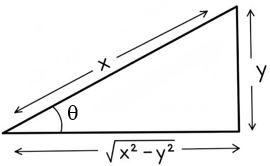
hypotenuse = x
side = y
(x+y) → constant
$\cos \theta=\frac{y}{x}$
area = $\frac{1}{2}\left(\sqrt{x^2-y^2}\right) \times y$ .....(1)
Let x + y = k ⇒ x = k - y
substituting in (1)
we get area = $\frac{1}{2} \sqrt{(k-y)^2-y^2} \times y$
area = $\frac{1}{2} \sqrt{k^2+y^2-y^2+2 k y} \times y$
area = $\frac{1}{2} \sqrt{k^2-2 k y} \times y$
squaring both sides
(area)2 = $\frac{1}{4}\left(k^2-2 k y\right) y^2$ [Let area2 = A]
$A=\frac{1}{4}\left(k^2 y^2-2 k y^3\right)$ ......(2)
for area maximum/minimum $\frac{dy}{dx} = 0$
differentiating (2)
$\frac{1}{4}\left(2 k^2 y-6 k y^2\right)=0$
$2 k^2 y=6 k y^2$
$k y=3 y^2$
$k=3 y$
$x+y=3 y$ (as k = x + y)
$x=2 y$
$\frac{x}{y}=2$
$\frac{1}{2} =\frac{y}{x}$
$\Rightarrow \cos \theta =\frac{1}{2}$ (as $\frac{y}{x} = \cos \theta$)
$\theta=\cos ^{-1}(\frac{1}{2})=\frac{\pi}{3}$