
The role of ethidium bromide in gel electrophoresis is:
Answer & explanation
Correct answer: option 4
The correct answer is Option (4) → To stain DNA which helps in identifying the desired DNA fragment under UV exposure
Gel electrophoresis separates DNA fragments by size. DNA is negatively charged, so in an electric field it moves through the agarose gel towards the positive electrode (anode); smaller fragments move farther. The band of the desired fragment, once seen, can be cut out of the gel (elution).
Option (1) To separate the DNA fragments in gel electrophoresis — Incorrect. The electric field and the gel separate the fragments, by charge and the sieving effect of agarose. Ethidium bromide is added only to see them.
Option (2) To speed up the electrophoresis — Incorrect. The speed depends on the voltage, the gel and the fragment size, not on the stain.
Option (3) To neutralize DNA fragments — Incorrect. If DNA lost its negative charge, it would not move to the anode at all, and electrophoresis would fail.
Option (4) To stain DNA which helps in identifying the desired DNA fragment under UV exposure — Correct. Staining with ethidium bromide and exposure to UV (ultraviolet) light make the DNA bands visible.
NCERT Extract:
Restriction Enzymes – “… The separated DNA fragments can be visualised only after staining the DNA with a compound known as ethidium bromide followed by exposure to UV radiation (you cannot see pure DNA fragments in the visible light and without staining). You can see bright orange coloured bands of DNA in a ethidium bromide stained gel exposed to UV light (Figure 9.3).”
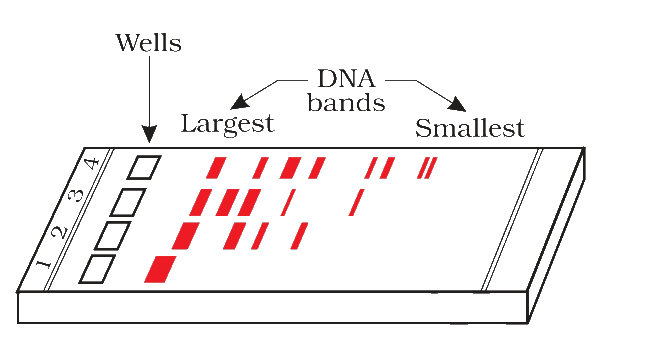
Figure 9.3 A typical agarose gel electrophoresis showing migration of undigested (lane 1) and digested set of DNA fragments (lane 2 to 4)