
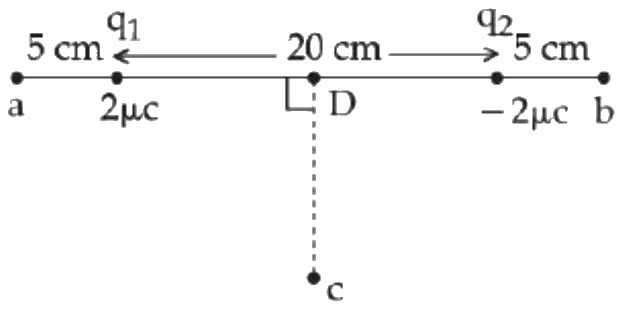
Two point charges \( q_1 = 2\,\mu\mathrm{C} \) and \( q_2 = -2\,\mu\mathrm{C} \) are placed 20 cm apart from each other. Point ‘a’ is 5 cm away from \( q_1 \), on the line joining \( q_1 \) and \( q_2 \) on the side opposite to \( q_2 \). Point ‘b’ is 5 cm away from \( q_2 \), on the line joining \( q_1 \) and \( q_2 \), opposite to \( q_1 \). Point ‘c’ is at a perpendicular distance of 10 cm from the centre point D of the line joining \( q_1 \) and \( q_2 \). Identify the correct statement depicting the situation.
Answer & explanation
Correct answer: option 1
The correct answer is Option (1) → Point C and D are equipotential
The potential due to point charges is the algebraic sum \( V = k\sum q_i/r_i \), with \( k = 9\times10^{9}\,\mathrm{N\,m^{2}\,C^{-2}} \). For an equal and opposite pair, every point on the perpendicular bisector is at the same distance from both charges, so the two contributions cancel.
\( \displaystyle V_D = V_c = k\left(\frac{q}{r} - \frac{q}{r}\right) = 0 \)
Point a is 5 cm from \( q_1 \) and \( 5 + 20 = 25 \) cm from \( q_2 \):
\( \displaystyle V_a = 9\times10^{9} \times 2\times10^{-6}\left(\frac{1}{0.05} - \frac{1}{0.25}\right) = 18000 \times 16 = 2.88\times10^{5}\,\mathrm{V} \)
Point b is placed in the same way next to the negative charge, so by symmetry
\( \displaystyle V_b = -2.88\times10^{5}\,\mathrm{V} \)
Option (1) Point C and D are equipotential — Correct. Both lie on the perpendicular bisector, where the potential is zero, so they are equipotential.
Option (2) Potential at point a, \( V_a \lt V_b \), potential at point b — Incorrect. \( V_a \) is positive and \( V_b \) negative, so \( V_a \gt V_b \).
Option (3) Potential at point a, \( V_a \lt V_c \), potential at point c — Incorrect. \( V_a \) is positive and \( V_c = 0 \), so \( V_a \gt V_c \).
Option (4) Potential at point D, \( V_D \lt V_b \) potential at point b — Incorrect. \( V_D = 0 \) and \( V_b \) is negative, so \( V_D \gt V_b \).
NCERT (2026-27):
Potential Due to an Electric Dipole – “… From Eq. (2.15), potential on the dipole axis (θ = 0, π) is given by
\( \displaystyle V = \pm\frac{1}{4\pi\varepsilon_0}\frac{p}{r^2} \qquad (2.16) \)
(Positive sign for θ = 0, negative sign for θ = π.) The potential in the equatorial plane (θ = π/2) is zero.”