
The figure shows two ways in which a hydroxide ion can collide with a molecule of CH3Br.
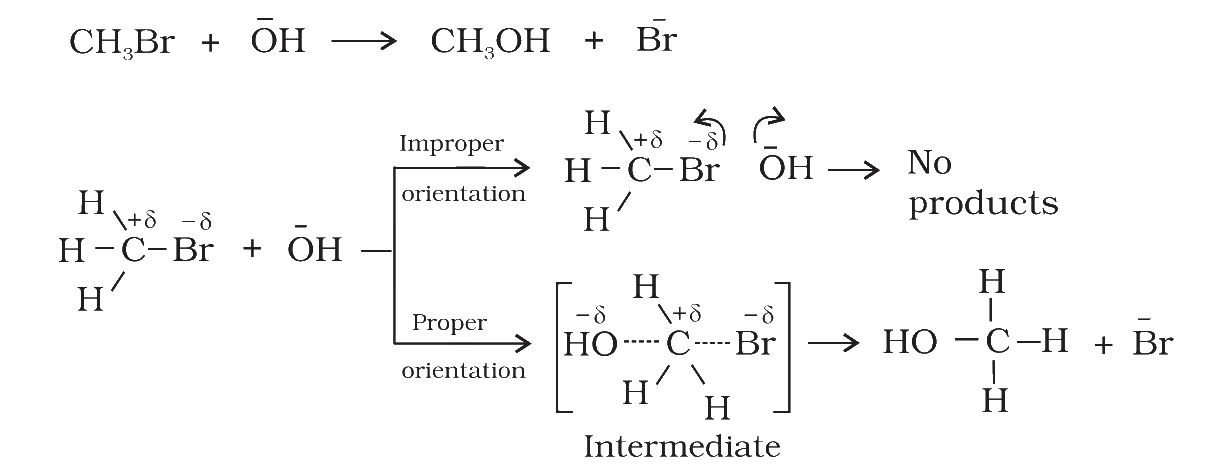
Which of the following describes the bonds in the intermediate formed on the path with proper orientation?
Answer & explanation
Correct answer: option 4
The correct answer is Option (4) → The C–O bond is forming and the C–Br bond is breaking.
An effective collision needs enough energy and the proper orientation, so that the old bond can break while the new bond forms.
Path with proper orientation — The OH− ion approaches the carbon atom from the side away from bromine.
The intermediate — In the bracketed intermediate, O and C are joined by a dotted line, and so are C and Br. The C–O bond is only partly made (forming), and the C–Br bond is only partly there (breaking). The three C–H bonds stay as full lines.
Products — When the change is complete, the intermediate gives CH3OH and Br−.
Why the other options are incorrect
Option (1) The C–Br bond is forming and the C–O bond is breaking. — Incorrect. This reverses the change: Br leaves as Br− and O stays bonded to carbon in CH3OH.
Option (2) The C–O bond and the C–Br bond are both complete. — Incorrect. Both bonds are drawn dotted, not as full lines.
Option (3) A C–H bond is breaking and the C–O bond is forming. — Incorrect. All three C–H bonds are drawn as full lines; no C–H bond breaks.
NCERT (2026-27 edition):
3.5 Collision Theory of Chemical Reactions – “The collisions in which molecules collide with sufficient kinetic energy (called threshold energy*) and proper orientation, so as to facilitate breaking of bonds between reacting species and formation of new bonds to form products are called as effective collisions. For example, formation of methanol … depends upon the orientation of reactant molecules as shown in Fig. 3.12. The proper orientation of reactant molecules lead to bond formation whereas improper orientation makes them simply bounce back and no products are formed.”
Fig. 3.12: Diagram showing molecules having proper and improper orientation