Which of the following hybridisation is correct for [FeF6]3−?
Answer & explanation
Correct answer: option 2
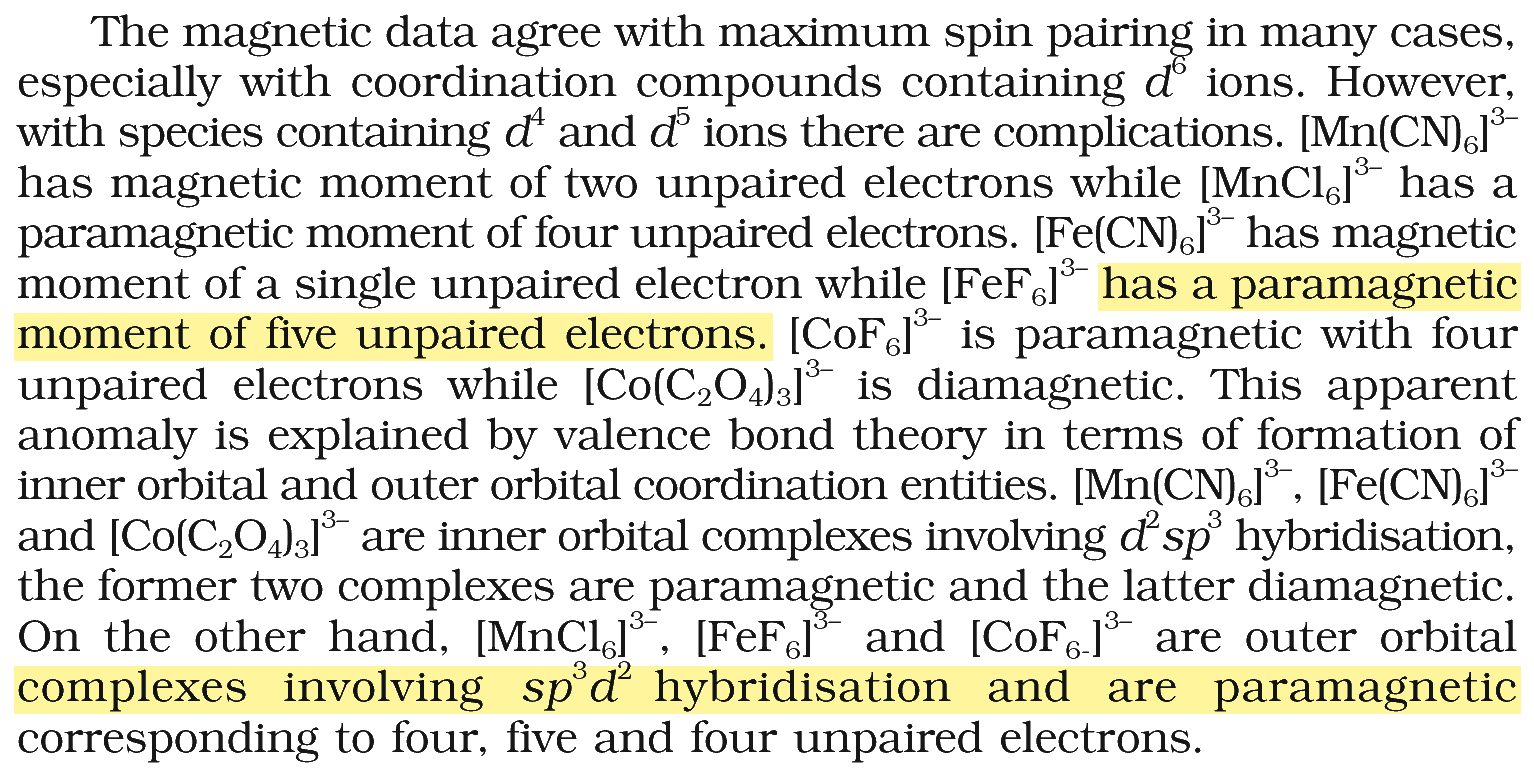
The correct answer is Option (2) → sp3d2 with 5 unpaired electrons
According to valence bond theory, an octahedral complex uses six hybrid orbitals of the metal. Which orbitals are used depends on the ligand:
Weak field ligands (such as \( \ce{F^{-}} \), \( \ce{H2O} \)) do not force the 3d electrons to pair. The inner 3d orbitals stay occupied, so the outer 4d orbitals are used: sp3d2, an outer orbital or high spin complex.
Strong field ligands (such as \( \ce{CN^{-}} \)) pair up the 3d electrons, leaving two inner 3d orbitals empty: d2sp3, an inner orbital or low spin complex.
In \( \ce{[FeF6]^{3-}} \), the oxidation state of iron is:
\( \displaystyle x+6(-1)=-3 \Rightarrow x=+3 \)
Fe (Z = 26) is [Ar]3d64s2; removing the two 4s electrons and one 3d electron gives \( \ce{Fe^{3+}} \): [Ar]3d5. \( \ce{F^{-}} \) is a weak field ligand, so the five 3d electrons stay unpaired, one in each 3d orbital. The six \( \ce{F^{-}} \) ligands use one 4s, three 4p and two 4d orbitals.
\( \displaystyle \mu=\sqrt{n(n+2)}=\sqrt{5\times7}=\sqrt{35}\approx5.92\ \mathrm{BM} \)
So \( \ce{[FeF6]^{3-}} \) is sp3d2 with 5 unpaired electrons.
Why the other options are incorrect
Option (1) sp3d2 with 1 unpaired electrons — Incorrect. Outer orbital hybridisation does not need any pairing, so all five 3d electrons remain unpaired.
Option (3) d2sp3 with 1 unpaired electrons — Incorrect. This describes \( \ce{[Fe(CN)6]^{3-}} \), where the strong field \( \ce{CN^{-}} \) ligands pair the electrons; \( \ce{F^{-}} \) cannot do this.
Option (4) d2sp3 with 5 unpaired electrons — Incorrect. To free two 3d orbitals, a d5 ion must pair four electrons, leaving only one unpaired. So d2sp3 with 5 unpaired electrons is impossible.
NCERT (2026-27 edition):
Magnetic Properties of Coordination Compounds – …