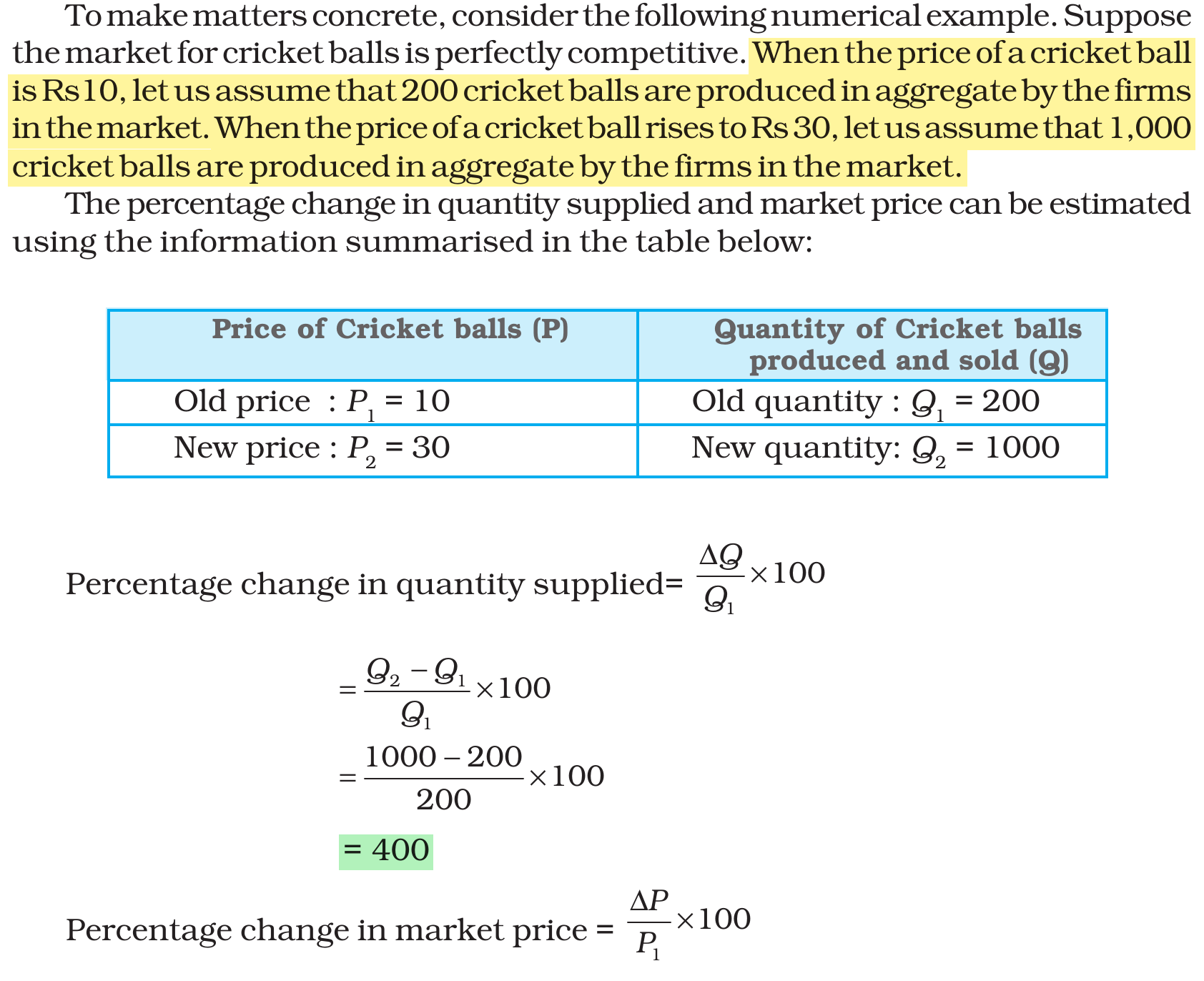
When the price of a cricket ball is Rs. 10, let us assume that 200 cricket balls are produced in aggregate by the firms in the market. When the price of a cricket ball rises to Rs. 30, let us assume that 1,000 cricket balls are produced in aggregate by the firms in the market. Calculate the elasticity of supply.
Answer & explanation
Correct answer: option 1
The correct answer is Option (1) → 2
Given:
Old price = Rs. 10
New price = Rs. 30
Old quantity = 200 cricket balls
New quantity = 1,000 cricket balls
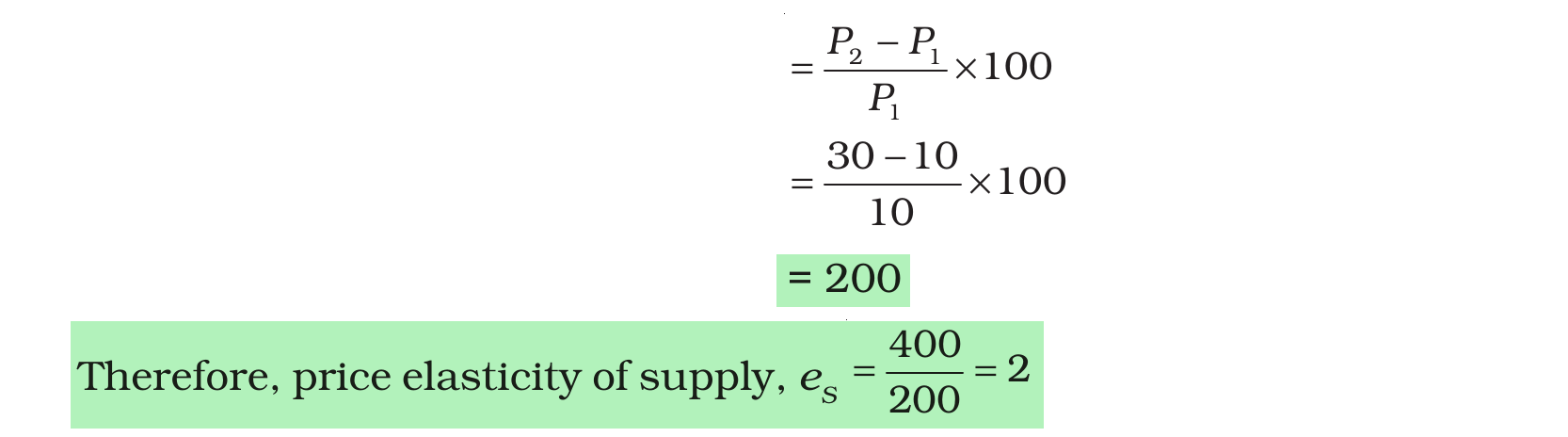
Price elasticity of supply (eS) is the percentage change in quantity supplied divided by the percentage change in price:
Percentage change in quantity = \( \displaystyle \frac{1000 - 200}{200} \times 100 \) = 400 per cent
Percentage change in price = \( \displaystyle \frac{30 - 10}{10} \times 100 \) = 200 per cent
eS = 400 ÷ 200 = 2
Note: This question is the worked example on price elasticity of supply in the chapter ‘The Theory of the Firm under Perfect Competition’ of the NCERT book. It has the same cricket balls and the same figures.
NCERT (2026-27): Introductory Microeconomics — Chapter 4: The Theory of the Firm under Perfect Competition
|