Arrange the following in chronological order:
A. STRATEGIC ARMS REDUCTION TREATY II (START II)
B. INDEFINITE EXTENSION OF THE NUCLEAR NON-PROLIFERATION TREATY (NPT)
C. STRATEGIC ARMS REDUCTION TREATY I (START I)
D. LIMITED TEST BAN TREATY (LTBT)
E. STRATEGIC ARMS LIMITATION TALKS II (SALT II)
Answer & explanation
Correct answer: option 4
The correct answer is Option (4) → D, E, C, A, B
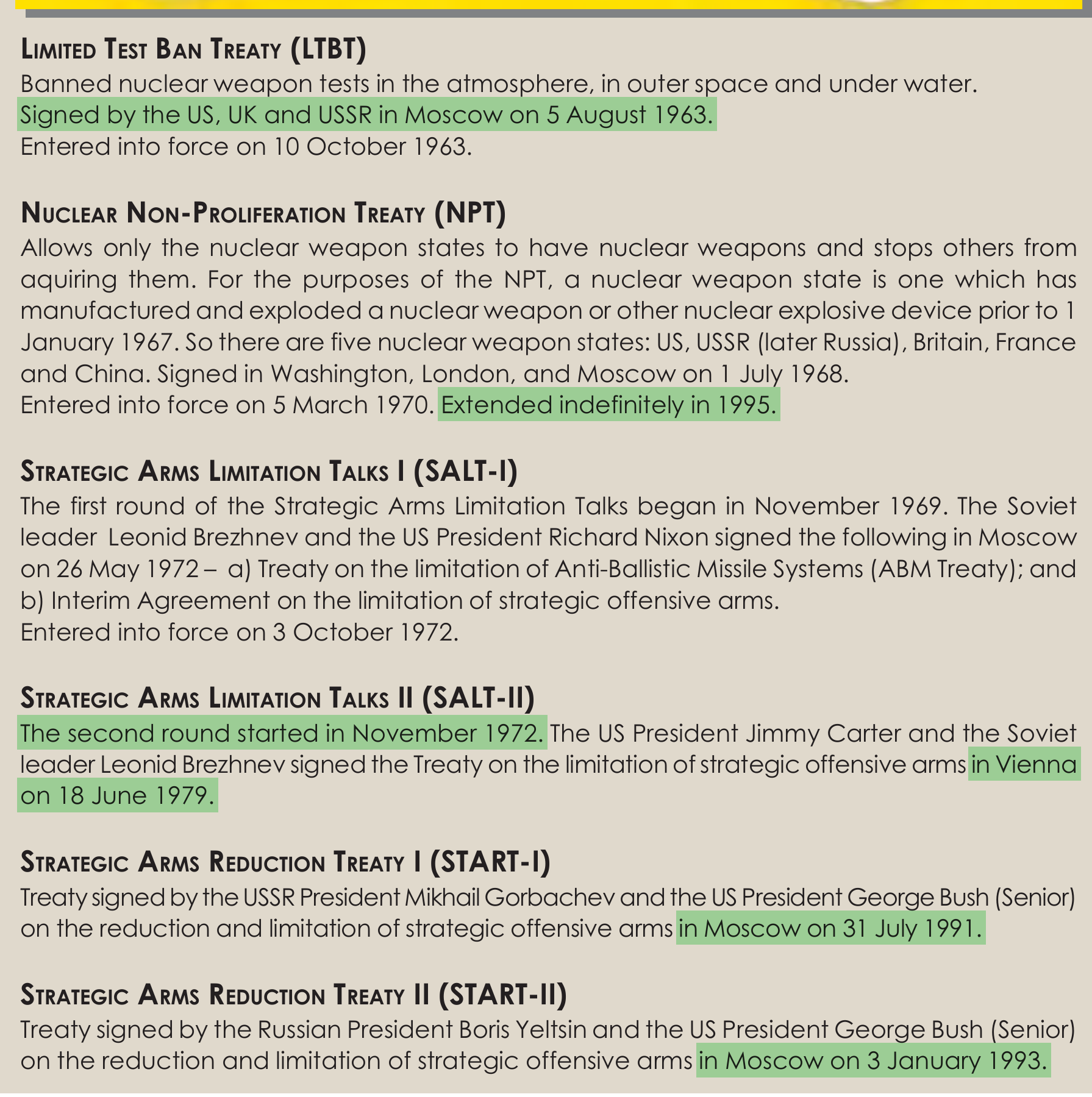
(D) Limited Test Ban Treaty (LTBT) — signed on 5 August 1963.
(E) Strategic Arms Limitation Talks II (SALT II) — the round started in November 1972, and the treaty was signed on 18 June 1979.
(C) Strategic Arms Reduction Treaty I (START I) — signed on 31 July 1991.
(A) Strategic Arms Reduction Treaty II (START II) — signed on 3 January 1993.
(B) Indefinite extension of the Nuclear Non-Proliferation Treaty (NPT) — the NPT, signed in 1968, was extended indefinitely in 1995.
Note: The box ‘Arms Control Treaties’, which gives the dates of these treaties, is from the chapter ‘The Cold War Era’, which was there in the pre-rationalised NCERT and has been deleted from subsequent editions of NCERT, including the NCERT book (2026-27). The NCERT book (2026-27) still names SALT II, START and the NPT of 1968 in the chapter ‘Security in the Contemporary World’, and the indefinite extension of the NPT in 1995 in the chapter ‘India’s External Relations’, but not the dates of the other treaties.
NCERT (2026-27): “Traditional Security and Cooperation … The US and Soviet Union signed a number of other arms control treaties including the Strategic Arms Limitations Treaty II or SALT II and the Strategic Arms Reduction Treaty (START). The Nuclear Non-Proliferation Treaty (NPT) of 1968 was an arms control treaty in the sense that it regulated the acquisition of nuclear weapons: those countries that had tested and manufactured nuclear weapons before 1967 were allowed to keep their weapons; and those that had not done so were to give up the right to acquire them. The NPT did not abolish nuclear weapons; rather, it limited the number of countries that could have them.” NCERT (2026-27), chapter ‘India’s External Relations’: “Fast Forward India’s Nuclear Programme … India has opposed the international treaties aimed at non-proliferation since they were selectively applicable to the non-nuclear powers and legitimised the monopoly of the five nuclear weapons powers. Thus, India opposed the indefinite extension of the NPT in 1995 and also refused to sign the Comprehensive Test Ban Treaty (CTBT).…” NCERT (Pre-rationalised): Contemporary World Politics — Chapter 1: The Cold War Era, box ‘Arms Control Treaties’
|