Match List-I with List-II
| List-I | List-II | ||
|---|---|---|---|
| (A) | Average Profits × 100/Normal Rate of Return | (I) | Normal Profit |
| (B) | Firm's Capital × Normal Rate of Return/100 | (II) | Goodwill |
| (C) | Total Profit /No.of years | (III) | Capitalised value of average profits |
| (D) | Super Profits × 100 /Normal Rate of Return | (IV) | Average Profit |
Choose the correct answer from the options given below:
Answer & explanation
Correct answer: option 3
The correct answer is Option (3) → (A) - (III), (B) - (I), (C) - (IV), (D) - (II)
Capitalising a profit means finding the capital that would earn it at the normal rate of return, which is done by multiplying the profit by 100 and dividing by the rate.
(A) Average Profits × 100/Normal Rate of Return — this matches (III) Capitalised value of average profits. It is the capital that would earn the average profit at the normal rate; goodwill under this method is this value minus the net assets.
(B) Firm’s Capital × Normal Rate of Return/100 — this matches (I) Normal Profit. It is the profit the capital employed would earn at the normal rate of the industry.
(C) Total Profit /No.of years — this matches (IV) Average Profit. The profits of the past years are added and divided by the number of years.
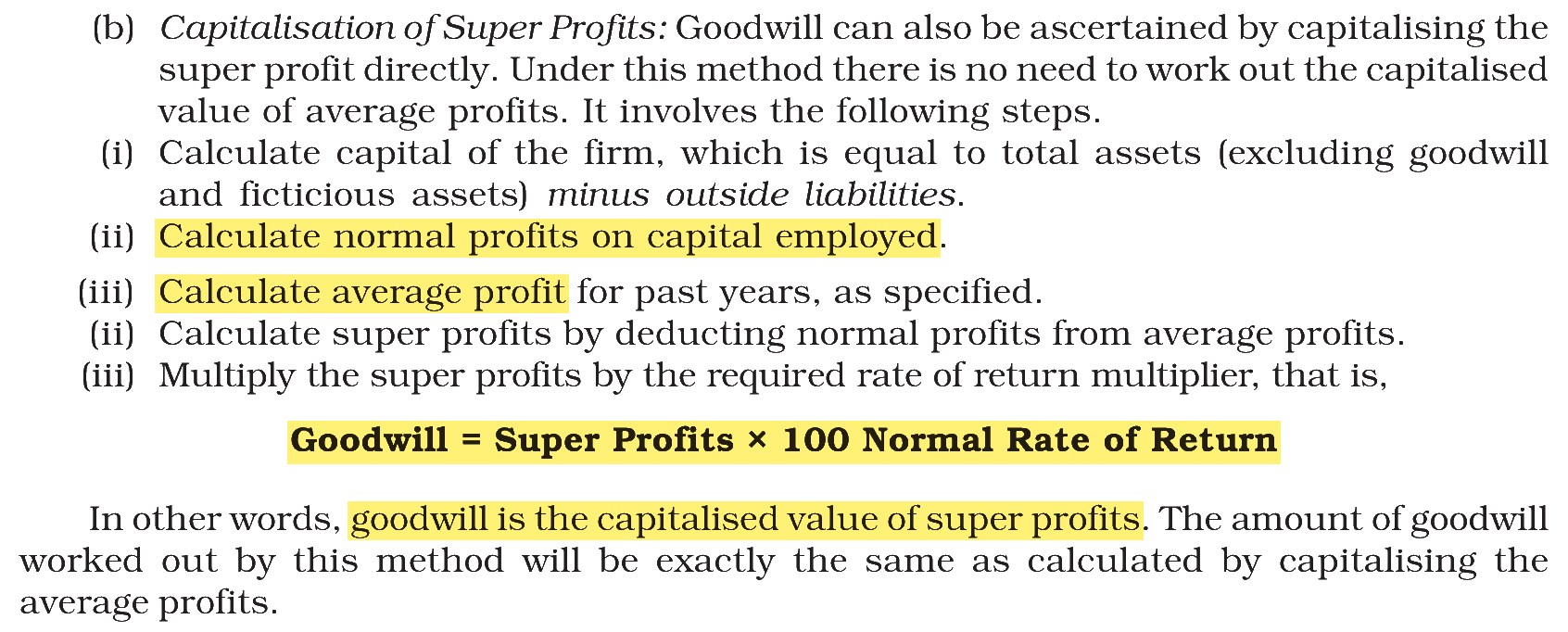
(D) Super Profits × 100 /Normal Rate of Return — this matches (II) Goodwill. Under the capitalisation of super profits method, goodwill is the capitalised value of the super profits.
NCERT (2026-27 edition):
|