During fertilisation, a sperm comes in contact with which layer of the ovum and induces changes that block the entry of additional sperms?
Answer & explanation
Correct answer: option 2
The correct answer is Option (2) → Zona pellucida
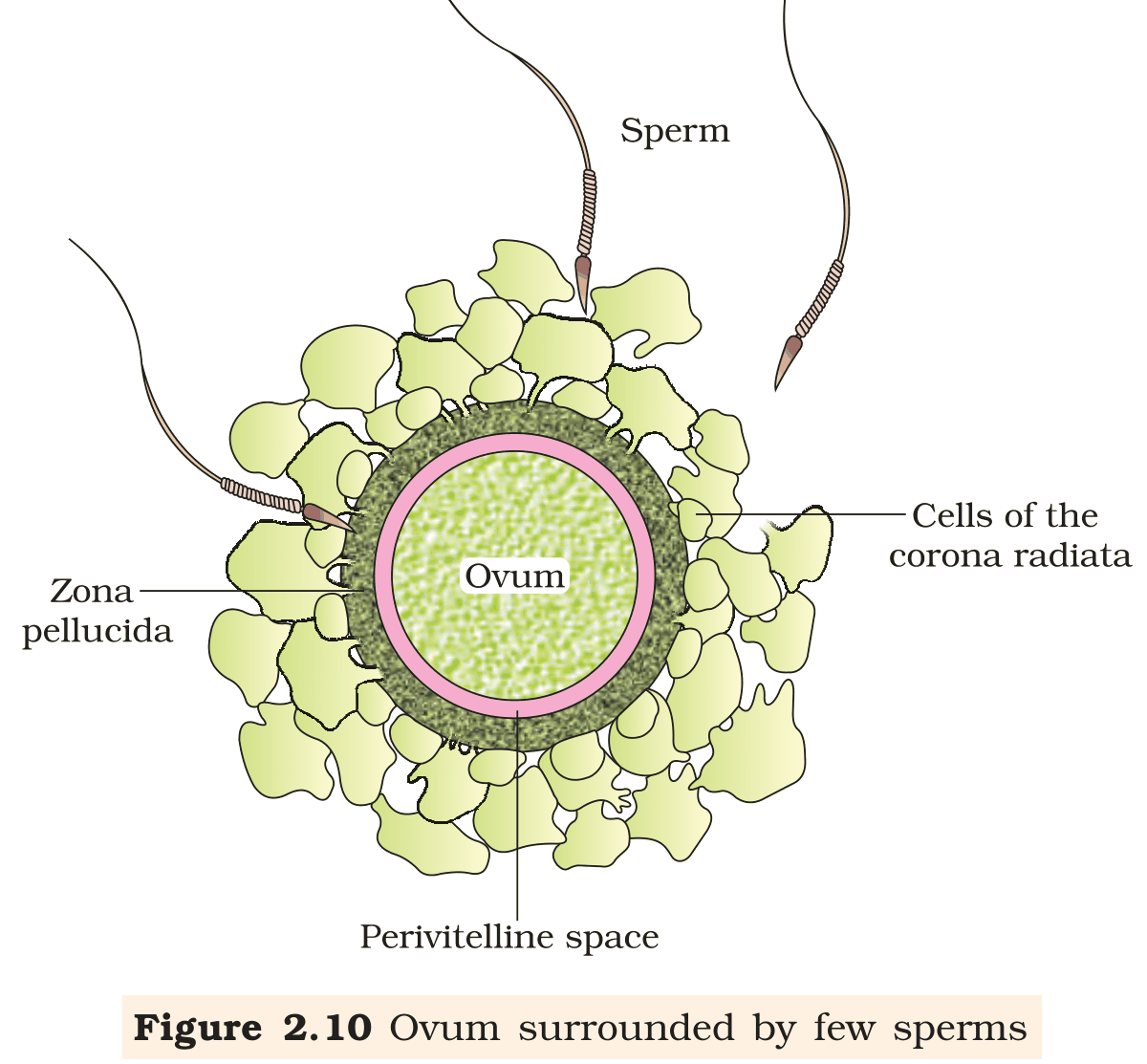
Several layers lie around the ovum: the ovum's own plasma membrane, the perivitelline space, the zona pellucida and the cells of the corona radiata (Figure 2.10). The sperm reaches the zona pellucida and the changes it induces there stop other sperms.
Option (1) Corona radiata — Incorrect. The cells of the corona radiata form the outermost layer around the ovum. The book does not give them any role in blocking sperms.
Option (2) Zona pellucida — Correct. The sperm comes in contact with the zona pellucida layer and induces changes in the membrane that block the entry of additional sperms. So only one sperm can fertilise an ovum.
Option (3) Perivitelline space — Incorrect. The perivitelline space is the narrow space between the zona pellucida and the ovum. It is a space, not a layer the sperm touches first.
Option (4) Theca interna — Incorrect. The theca interna is part of the theca layer of the tertiary follicle in the ovary. It is not around the ovum at fertilisation.
NCERT Extract:
Fertilisation and Implantation – “… The process of fusion of a sperm with an ovum is called fertilisation. During fertilisation, a sperm comes in contact with the zona pellucida layer of the ovum (Figure 2.10) and induces changes in the membrane that block the entry of additional sperms. Thus, it ensures that only one sperm can fertilise an ovum.”